MyCompetitiveExams Logo MyCompetitiveExams
Search 1,140+ Questions
Chapters, formulas, speed tricks
→
⚡ Brahmastra NEET 2027
720 MARKS

Dynamic 180-question full-length simulator mixed dynamically from all 6 years for 2027 & 2026 aspirants.

Launch Brahmastra 2027 Test →
Start Practice →
100% Free · No Login Required
Q.152 Zoology ⭐ 360° Option Elimination Active
Vault ↗

NEET 2026 Zoology Question 152 Solution

Topic: Locomotion and Movement · Official NTA Booklet Code 50
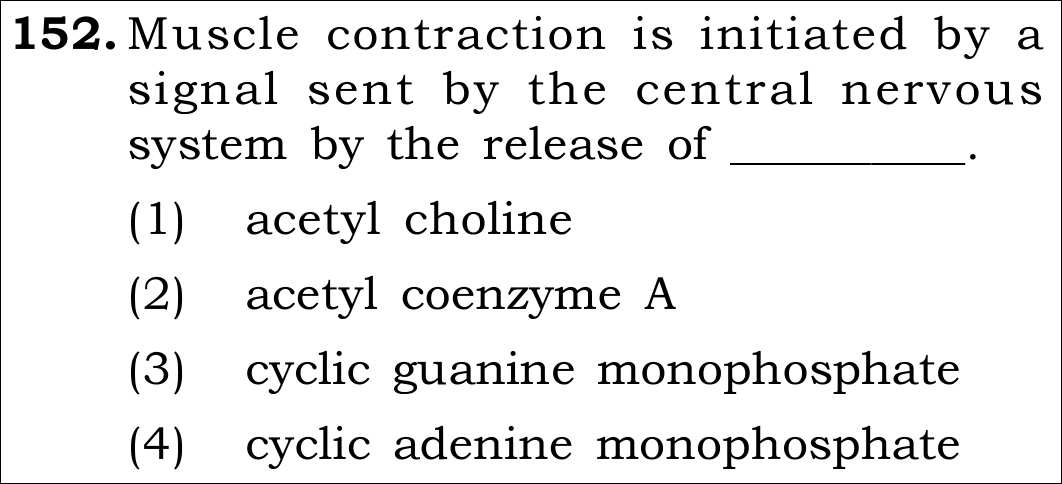
NEET 2026 Zoology Question 152: Neuromuscular Junction & Acetylcholine Release

Question

Muscle contraction is initiated by a signal sent by the central nervous system by the release of.

✓
Verified Against NTA Final Answer Key
Option (1) : Acetyl choline
📚 Locomotion and Movement Easy
📋 Given Parameters & Problem Setup
Site of Action Neuromuscular Junction (Motor End Plate)
Trigger CNS motor neuron action potential
Target Effect Action potential generation in sarcolemma
⚡

The 30-Second Exam Hall Shortcut: ⚡ Motor End Plate Gold Standard

⏱️ Save ~40 seconds

Skeletal Neuromuscular Junction = Always Acetylcholine (ACh)!

1 Identify target synapse: Motor neuron junction with skeletal muscle sarcolemma.
2 Recall the primary excitatory neurotransmitter of the vertebrate motor end plate: Acetylcholine.
3 When action potential arrives at axonal terminal, voltage-gated Ca²⁺ influx causes exocytosis of ACh vesicles into the synaptic cleft.
4 ACh binds nicotinic receptors on the sarcolemma, opening Na⁺ channels.
5 Select Option (1): Acetyl choline in 5 seconds.
🛡️
Why You Can 100% Trust This Shortcut: NCERT Biology · Locomotion and Movement (Sliding Filament Theory: Actin filaments slide over myosin during muscle contraction).
📐

Step-by-Step Rigorous Workflow & Mathematical Proof

Step 1

Neuromuscular Junction Organization

A neural signal reaching the neuromuscular junction (the junction between a motor neuron and the sarcolemma of the muscle fibre) releases a neurotransmitter (acetylcholine) which generates an action potential in the sarcolemma.

Axon Terminal Action Potential→Ca2+ InfluxExocytosis of ACh→Synaptic CleftSarcolemma Depolarization\text{Axon Terminal Action Potential} \xrightarrow{\text{Ca}^{2+} \text{ Influx}} \text{Exocytosis of ACh} \xrightarrow{\text{Synaptic Cleft}} \text{Sarcolemma Depolarization}
  • • Vesicles in synaptic knobs fuse with presynaptic membrane and release ACh into synaptic cleft.
Step 2

Excitation-Contraction Coupling

This spreads through the muscle fibre and causes the release of calcium ions into the sarcoplasm from the sarcoplasmic reticulum, initiating sliding filament contraction.

Action Potential→T-tubulesSarcoplasmic Reticulum→Release of Ca2+Troponin C Binding\text{Action Potential} \xrightarrow{\text{T-tubules}} \text{Sarcoplasmic Reticulum} \xrightarrow{\text{Release of Ca}^{2+}} \text{Troponin C Binding}
  • • Acetylcholinesterase subsequently degrades ACh to terminate muscle stimulation.
⭐

360° Option Elimination Engine Key Feature

Diagnose every choice: Know exactly why the right option works and why distractors fail.

4-Option Deep Scan
1 A
✓ 100% Correct
Verdict & Scientific Reason:

100% correct. Acetylcholine is the universal neurotransmitter at vertebrate neuromuscular junctions.

💡
Why this is airtight: None; standard textbook knowledge.
2 B
✗ Incorrect
Verdict & Scientific Reason:

Incorrect. Adrenaline (epinephrine) is an adrenal medullary hormone and sympathetic neurotransmitter, not the motor end plate neurotransmitter.

⚠️
Student Fallacy (Why candidates pick this trap): Confusing sympathetic fight-or-flight hormones with somatic motor neurotransmitters.
3 C
✗ Incorrect
Verdict & Scientific Reason:

Incorrect. Noradrenaline is the postganglionic sympathetic neurotransmitter for smooth muscles and cardiac tissue.

⚠️
Student Fallacy (Why candidates pick this trap): Confusing autonomic nervous system with somatic skeletal motor innervation.
4 D
✗ Incorrect
Verdict & Scientific Reason:

Incorrect. Dopamine is a central nervous system neurotransmitter (involved in reward and basal ganglia motor control), not released at the peripheral neuromuscular junction.

⚠️
Student Fallacy (Why candidates pick this trap): Associating dopamine with motor coordination and wrongly placing it at muscle end plates.
⚠️

NTA Trap Alert: Autonomic vs. Somatic Neurotransmitter Mix-up

Students sometimes confuse sympathetic neurotransmitters (adrenaline/noradrenaline) with somatic motor neuron transmitters. Somatic motor neurons exclusively release acetylcholine onto nicotinic receptors.

🛡️ How to avoid the -1 mark: Remember: Somatic motor neuron -> Skeletal muscle ALWAYS equals Acetylcholine (ACh).
📖

Core NEET Syllabus Standard

NEET Biology Core Syllabus · Locomotion and Movement Standard Benchmark
Core Scientific Principle Tested:

"Neuromuscular junction releases acetylcholine to generate an action potential in the sarcolemma."

Syllabus Focus: Mechanism of Muscle Contraction
✓ Core NEET UG Syllabus Anchor Syllabus & Academic Standards ↗
ACh = Action of Contraction Happens!

Ready to attempt under real exam pressure?

Test your speed and accuracy in the authentic 180-minute timed NTA simulator.

Launch NEET 2026 CBT Test →

Spotted a mistake in this solution? Report an error ([email protected])

⚖️ Legal & Fair Dealing Notice: Sourced from publicly released NEET 2026 question papers and NEET answer keys for private study, research, and non-commercial educational practice under Fair Dealing (Section 52(1)(a) of the Indian Copyright Act, 1957). Not affiliated with or endorsed by NTA or NMC.

Solve 4 NEET Questions a Day — One per Subject

Cover all 1,140 official NEET questions in 285 days at your own pace. Progress is saved on your device. No login needed.