MyCompetitiveExams Logo MyCompetitiveExams
Search 1,140+ Questions
Chapters, formulas, speed tricks
→
⚡ Brahmastra NEET 2027
720 MARKS

Dynamic 180-question full-length simulator mixed dynamically from all 6 years for 2027 & 2026 aspirants.

Launch Brahmastra 2027 Test →
Start Practice →
100% Free · No Login Required
Q.148 Botany ⭐ 360° Option Elimination Active
Vault ↗

NEET 2024 Botany Question 148 Solution

Topic: Molecular Basis of Inheritance · Official NTA Booklet Code T1
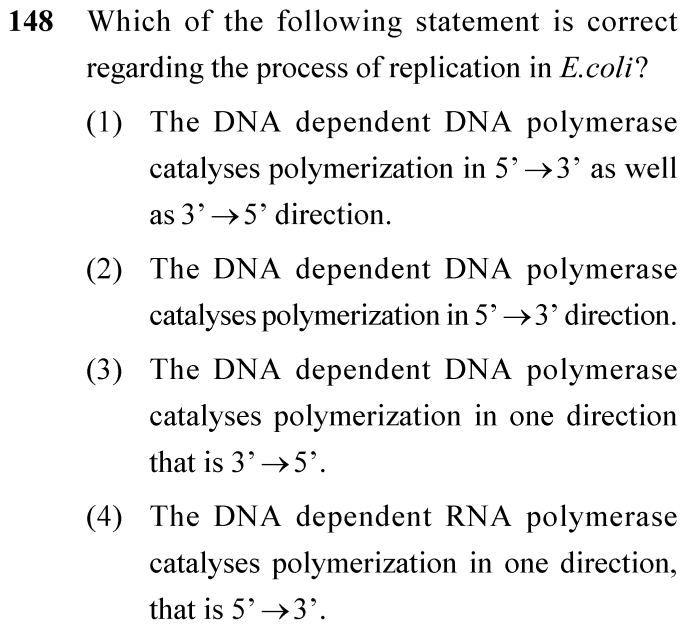
NEET 2024 Botany Question 148: Catalytic Directionality of DNA-Dependent DNA Polymerase

Question

Which of the following statement is correct regarding the process of replication in E.coli?

  1. (1)The DNA dependent DNA polymerase catalyses polymerization in 5' 3' as well as 3' 5' direction.
  2. (2)The DNA dependent DNA polymerase catalyses polymerization in 5' +3' direction.
  3. (3)The DNA dependent DNA polymerase catalyses polymerization in one direction that is 3' 5'.
  4. (4)The DNA dependent RNA polymerase catalyses polymerization in one direction, that is 5' 3'.
✓
Verified Against NTA Final Answer Key
Option (2) : The DNA dependent DNA polymerase catalyses polymerization in 5' -> 3' direction.
📚 Molecular Basis of Inheritance Easy
📋 Given Parameters & Problem Setup
Process Replication in Escherichia coli
Key Enzyme DNA-dependent DNA polymerase (DNA Pol III)
⚡

The 30-Second Exam Hall Shortcut: ⚡ Universal Polymerization Polarity

⏱️ Save ~20 seconds

ALL DNA and RNA polymerases synthesize new nucleic acid chains strictly in the 5' -> 3' direction (adding new nucleotides to the free 3'-OH group)!

1 Recall polymerase catalytic directionality:
2 - DNA-dependent DNA polymerase catalyses polymerization ONLY in the 5' -> 3' direction.
3 - Because of this unidirectional constraint, on one strand (template 3'->5') replication is continuous (leading strand), while on the other (template 5'->3') it is discontinuous (lagging strand/Okazaki fragments).
4 Option (2) states: "catalyses polymerization in 5' -> 3' direction" -> Option (2) / B.
🛡️
Why You Can 100% Trust This Shortcut: NCERT Biology · Molecular Basis of Inheritance (DNA Replication Machinery and Directionality)
📐

Step-by-Step Rigorous Workflow & Mathematical Proof

Step 1

Understand Polymerase Enzymatic Requirements

In living cells, such as E. coli, the main enzyme is DNA-dependent DNA polymerase. It uses a DNA template to catalyse the polymerisation of deoxynucleotides with high speed and exceptional fidelity.

Step 2

Directionality of Catalysis

The DNA-dependent DNA polymerases catalyse polymerisation only in one direction, that is, 5′→3′5' \rightarrow 3'. Nucleotides can only be added to a pre-existing free 3′-OH3'\text{-OH} group on the elongating strand.

Step 3

Impact on Replication Fork

Consequently, at the replication fork, one strand (template with polarity 3′→5′3' \rightarrow 5') experiences continuous synthesis, whereas the other strand (template with polarity 5′→3′5' \rightarrow 3') experiences discontinuous synthesis.

⭐

360° Option Elimination Engine Key Feature

Diagnose every choice: Know exactly why the right option works and why distractors fail.

4-Option Deep Scan
1 (1)
✗ Incorrect
Verdict & Scientific Reason:

Polymerisation can never occur in the 3' -> 5' direction; 3' -> 5' activity is exonucleolytic proofreading, not polymerisation.

⚠️
Student Fallacy (Why candidates pick this trap): Polymerisation can never occur in the 3' -> 5' direction; 3' -> 5' activity is exonucleolytic proofreading, not polymerisation.
2 (2)
✓ 100% Correct
Verdict & Scientific Reason:

Correctly identifies that polymerisation occurs exclusively in the 5' to 3' direction.

💡
Why this is airtight: None.
3 (3)
✗ Incorrect
Verdict & Scientific Reason:

Polymerisation proceeds 5' -> 3', not 3' -> 5'.

⚠️
Student Fallacy (Why candidates pick this trap): Polymerisation proceeds 5' -> 3', not 3' -> 5'.
4 (4)
✗ Incorrect
Verdict & Scientific Reason:

While RNA polymerase also synthesizes 5' -> 3', the question specifically focuses on the process of DNA replication in E. coli.

⚠️
Student Fallacy (Why candidates pick this trap): While RNA polymerase also synthesizes 5' -> 3', the question specifically focuses on the process of DNA replication in E. coli.
⚠️

NTA Trap Alert: Template Polarity vs Synthesis Polarity

Confusing the template reading direction (3' to 5') with the new strand synthesis direction (5' to 3').

🛡️ How to avoid the -1 mark: Templates are read 3' to 5'; new DNA is ALWAYS synthesized 5' to 3'.
📖

Core NEET Syllabus Standard

Biology Core Botany · Molecular Basis of Inheritance Standard Benchmark
Core Scientific Principle Tested:

"The DNA-dependent DNA polymerases catalyse polymerisation only in one direction, that is, 5'->3'. This creates some additional complications at the replicating fork. Consequently, on one strand (the template with polarity 3'->5'), the replication is continuous, while on the other (the template with polarity 5'->3'), it is discontinuous."

Syllabus Focus: Catalytic Directionality of DNA-Dependent DNA Polymerase
✓ Core NEET UG Syllabus Anchor Syllabus & Academic Standards ↗

Ready to attempt under real exam pressure?

Test your speed and accuracy in the authentic 200-minute timed NTA simulator.

Launch NEET 2024 CBT Test →

Spotted a mistake in this solution? Report an error ([email protected])

⚖️ Legal & Fair Dealing Notice: Sourced from publicly released NEET 2024 question papers and NEET answer keys for private study, research, and non-commercial educational practice under Fair Dealing (Section 52(1)(a) of the Indian Copyright Act, 1957). Not affiliated with or endorsed by NTA or NMC.

Solve 4 NEET Questions a Day — One per Subject

Cover all 1,140 official NEET questions in 285 days at your own pace. Progress is saved on your device. No login needed.