NEET 2024 Botany Question 108 Solution
Question
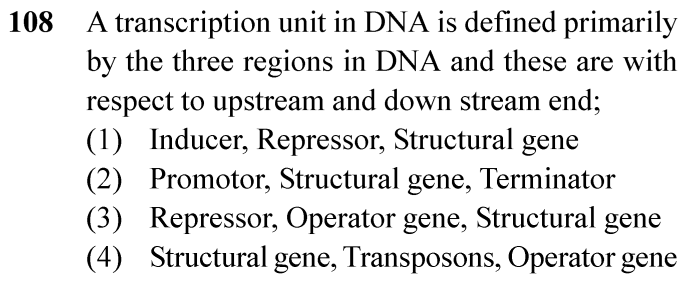
A transcription unit in DNA is defined primarily by the three regions in DNA and these are with respect to upstream and downstream end:
Dynamic 180-question full-length simulator mixed dynamically from all 6 years for 2027 & 2026 aspirants.
A transcription unit in DNA is defined primarily by the three regions in DNA and these are with respect to upstream and downstream end:
Transcription unit order is always: Promoter (upstream) -> Structural gene (middle) -> Terminator (downstream)!
A transcription unit in DNA is defined primarily by three regions: a Promoter, the Structural gene, and a Terminator.
By convention, positions of sequence elements are defined with respect to the coding strand (5' to 3'). The promoter is situated towards the 5'-end (upstream). It provides the binding site for RNA polymerase. The structural gene lies between the promoter and terminator. The terminator is situated towards the 3'-end (downstream) and defines the end of transcription.
Reading from upstream to downstream yields: Promoter -> Structural gene -> Terminator.
Diagnose every choice: Know exactly why the right option works and why distractors fail.
Structural gene is in the middle, not upstream of the promoter.
Correct canonical sequence from upstream (5') to downstream (3').
Terminator is downstream at the 3'-end, not the initiating upstream element.
Structural gene is transcribed before transcription terminates at the terminator.
Thinking with respect to the template strand instead of the standard coding strand reference.
"A transcription unit in DNA is defined primarily by the three regions: (i) A Promoter (ii) The Structural gene (iii) A Terminator. The promoter is said to be located towards 5'-end (upstream) of the structural gene (the reference is made with respect to the polarity of coding strand)."
Test your speed and accuracy in the authentic 200-minute timed NTA simulator.
Spotted a mistake in this solution? Report an error ([email protected])
Cover all 1,140 official NEET questions in 285 days at your own pace. Progress is saved on your device. No login needed.