MyCompetitiveExams Logo MyCompetitiveExams
Search 1,140+ Questions
Chapters, formulas, speed tricks
→
⚡ Brahmastra NEET 2027
720 MARKS

Dynamic 180-question full-length simulator mixed dynamically from all 6 years for 2027 & 2026 aspirants.

Launch Brahmastra 2027 Test →
Start Practice →
100% Free · No Login Required
Q.37 Physics ⭐ 360° Option Elimination Active
Vault ↗

NEET 2023 Physics Question 37 Solution

Topic: Ray Optics and Optical Instruments · Official NTA Booklet Code G5
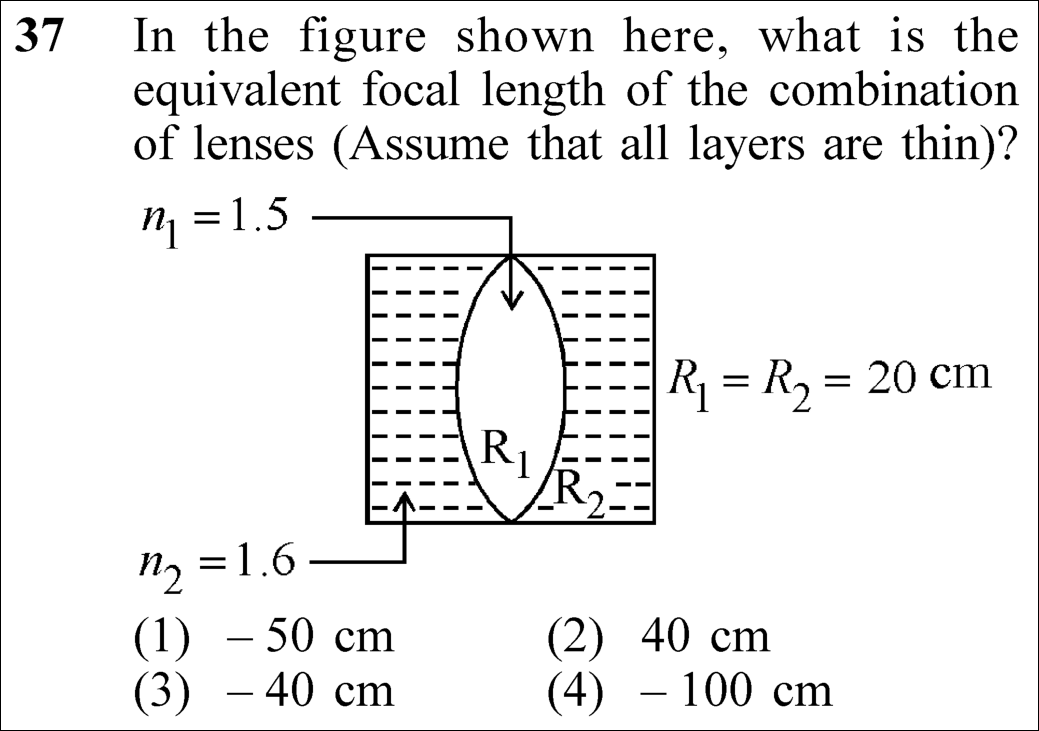
NEET 2023 Physics Question 37: Focal Length of Composite Glass Lens and Liquid Layers

Question

In the figure shown here, what is the equivalent focal length of the combination of lenses (Assume that all layers are thin)?

✓
Verified Against NTA Final Answer Key
Option (4) : -100 cm
📚 Ray Optics and Optical Instruments Medium
📋 Given Parameters & Problem Setup
Central convex lens index (n₁) 1.5
Radii of curvature of central lens R₁ = 20 cm, R₂ = 20 cm
Surrounding medium index (n₂) 1.6
Shape of surrounding layers Two plano-concave liquid lenses with R = 20 cm
⚡

The 30-Second Exam Hall Shortcut: ⚡ Power Addition Rule: 1/F = 1/f₁ + 1/f₂ + 1/f₃

⏱️ Save ~60 seconds

Central lens: 1/f₂ = (1.5-1)(1/20 + 1/20) = +1/20 = +5/100. Each liquid lens: 1/f = (1.6-1)(0 - 1/20) = -3/100. Total power 1/F = -3/100 + 5/100 - 3/100 = -1/100 ⟹ F = -100 cm in 30 seconds!

1 Decompose the system into three thin lenses in contact: two identical plano-concave liquid lenses (n₂ = 1.6) and one equiconvex lens (n₁ = 1.5).
2 For equiconvex glass lens: 1/f₂ = (n₁ - 1)(1/R₁ - 1/R₂) = (1.5 - 1)(1/20 - (-1/20)) = 0.5 × (2/20) = +1/20 cm⁻¹ = +5/100 cm⁻¹.
3 For each plano-concave liquid lens: 1/f_liquid = (n₂ - 1)(1/∞ - 1/20) = 0.6 × (-1/20) = -0.6/20 = -3/100 cm⁻¹.
4 Net power of thin lenses in contact: 1/F = 1/f₁ + 1/f₂ + 1/f₃ = (-3/100) + (+5/100) + (-3/100) = -1/100 cm⁻¹.
5 Equivalent focal length: F = -100 cm.
6 Lock Option (4) -100 cm with total conviction!
🛡️
Why You Can 100% Trust This Shortcut: Ray Optics · Lens Maker’s Formula (The equivalent optical power of thin coaxial lenses in contact is the algebraic sum of their individual powers: 1/F = Σ 1/f_i).
📐

Step-by-Step Rigorous Workflow & Mathematical Proof

Step 1

Decomposition of the Composite Optical System

The given optical system consists of three thin lenses placed in contact along a common optical axis: (i) a first plano-concave lens made of the medium of refractive index n₂ = 1.6, (ii) an equiconvex lens made of material of refractive index n₁ = 1.5, and (iii) a second plano-concave lens made of the medium of refractive index n₂ = 1.6.

1Feq=1f1+1f2+1f3\frac{1}{F_{\text{eq}}} = \frac{1}{f_1} + \frac{1}{f_2} + \frac{1}{f_3}
Step 2

Focal Length of the Central Convex Lens (f₂)

Using the Lens Maker’s Formula for the central equiconvex lens in air with R₁ = +20 cm and R₂ = -20 cm:

1f2=(n1−1)(1R1−1R2)=(1.5−1)(120−(−120))=0.5×220=+120 cm−1=+5100 cm−1\frac{1}{f_2} = (n_1 - 1)\left(\frac{1}{R_1} - \frac{1}{R_2}\right) = (1.5 - 1)\left(\frac{1}{20} - \left(-\frac{1}{20}\right)\right) = 0.5 \times \frac{2}{20} = +\frac{1}{20}\text{ cm}^{-1} = +\frac{5}{100}\text{ cm}^{-1}
Step 3

Focal Length of the Left and Right Plano-Concave Lenses (f₁, f₃)

For the left plano-concave lens, the first surface is plane (R = ∞) and the second surface has radius of curvature R = +20 cm:

1f1=(n2−1)(1∞−120)=(1.6−1)(−120)=−0.620=−3100 cm−1\frac{1}{f_1} = (n_2 - 1)\left(\frac{1}{\infty} - \frac{1}{20}\right) = (1.6 - 1)\left(-\frac{1}{20}\right) = -\frac{0.6}{20} = -\frac{3}{100}\text{ cm}^{-1}
Step 4

Summation of Individual Lens Powers

Because the right plano-concave lens is identical in curvature and material, 1/f₃ = -3/100 cm⁻¹. Summing all three powers:

1F=(−3100)+(+5100)+(−3100)=−3+5−3100=−1100 cm−1\frac{1}{F} = \left(-\frac{3}{100}\right) + \left(+\frac{5}{100}\right) + \left(-\frac{3}{100}\right) = \frac{-3 + 5 - 3}{100} = -\frac{1}{100}\text{ cm}^{-1}
Step 5

Determination of Equivalent Focal Length

Inverting yields the net focal length of the combination:

F=−100 cmF = -100\text{ cm}
⭐

360° Option Elimination Engine Key Feature

Diagnose every choice: Know exactly why the right option works and why distractors fail.

4-Option Deep Scan
1 (1)
✗ Incorrect
Verdict & Scientific Reason:

Corresponds to omitting one of the two plano-concave liquid lenses (-3/100 + 5/100 = +2/100 ⟹ +50 cm).

⚠️
Student Fallacy (Why candidates pick this trap): Candidate forgot the second liquid layer.
2 (2)
✗ Incorrect
Verdict & Scientific Reason:

Incorrect sign and magnitude.

⚠️
Student Fallacy (Why candidates pick this trap): Candidate treated the liquid lenses as convex instead of concave.
3 (3)
✗ Incorrect
Verdict & Scientific Reason:

Arithmetic slip in sign or curvature substitution.

⚠️
Student Fallacy (Why candidates pick this trap): Candidate made an error combining powers.
4 (4)
✓ 100% Correct
Verdict & Scientific Reason:

Accurate equivalent focal length matching Lens Maker’s Formula and NTA final answer key.

💡
Why this is airtight: None. Candidate correctly analyzed all three thin lens elements.
⚠️

NTA Trap Alert: Forgetting That Liquid Fills Both Sides (Two Concave Lenses)

The figure shows liquid on BOTH sides of the central lens, forming TWO plano-concave lenses. Candidates who treat the liquid as only one lens arrive at +50 cm or -50 cm.

🛡️ How to avoid the -1 mark: Count every boundary: Flat left + curved central + flat right = 3 distinct lens regions.
📖

Core NEET Syllabus Standard

National Eligibility cum Entrance Test (NEET UG) · Ray Optics and Optical Instruments Standard Benchmark
Core Scientific Principle Tested:

"Net focal length of thin lenses in contact satisfies 1/F = Σ (n_i - 1)(1/R₁ - 1/R₂)."

Syllabus Focus: Combination of Thin Lenses and Lens Maker’s Formula
Preserved in Rationalized Curriculum Syllabus & Academic Standards ↗

Ready to attempt under real exam pressure?

Test your speed and accuracy in the authentic 200-minute timed NTA simulator.

Launch NEET 2023 CBT Test →

Spotted a mistake in this solution? Report an error ([email protected])

⚖️ Legal & Fair Dealing Notice: Sourced from publicly released NEET 2023 question papers and NEET answer keys for private study, research, and non-commercial educational practice under Fair Dealing (Section 52(1)(a) of the Indian Copyright Act, 1957). Not affiliated with or endorsed by NTA or NMC.

Solve 4 NEET Questions a Day — One per Subject

Cover all 1,140 official NEET questions in 285 days at your own pace. Progress is saved on your device. No login needed.