MyCompetitiveExams Logo MyCompetitiveExams
Search 1,140+ Questions
Chapters, formulas, speed tricks
→
⚡ Brahmastra NEET 2027
720 MARKS

Dynamic 180-question full-length simulator mixed dynamically from all 6 years for 2027 & 2026 aspirants.

Launch Brahmastra 2027 Test →
Start Practice →
100% Free · No Login Required
Q.38 Physics ⭐ 360° Option Elimination Active
Vault ↗

NEET 2023 Physics Question 38 Solution

Topic: Motion in a Straight Line · Official NTA Booklet Code G5
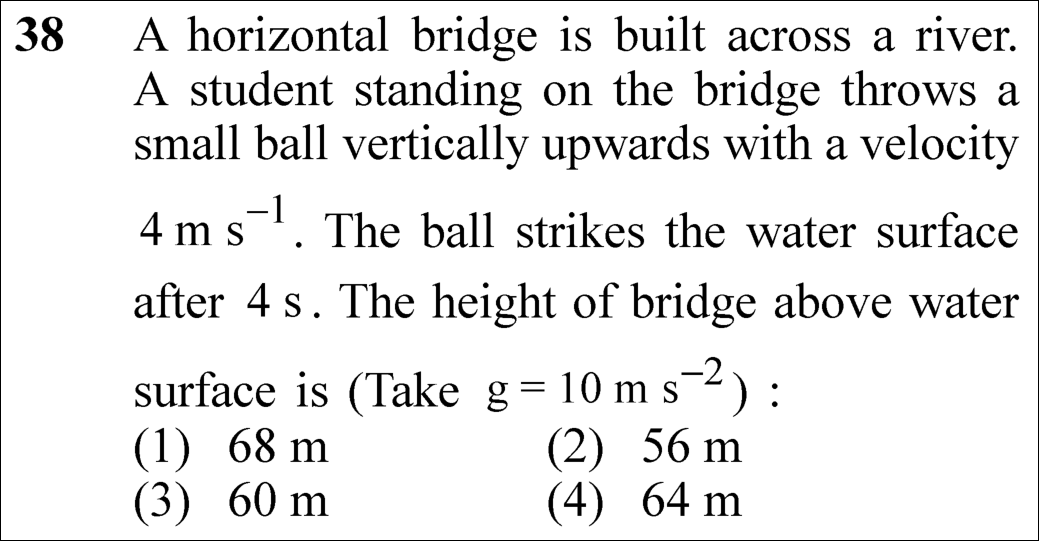
NEET 2023 Physics Question 38: Height of Bridge from Time of Flight of Upwardly Projected Particle

Question

A horizontal bridge is built across a river. A student standing on the bridge throws a small ball vertically upwards with a velocity 4 m s⁻¹. The ball strikes the water surface after 4 s. The height of bridge above water surface is (Take g = 10 m s⁻²):

✓
Verified Against NTA Final Answer Key
Option (4) : 64 m
📚 Motion in a Straight Line Easy
📋 Given Parameters & Problem Setup
Initial upward velocity (u) +4 m s⁻¹
Acceleration due to gravity (g) -10 m s⁻² (downward)
Total time to strike water (t) 4 s
Height of bridge (h) To be determined (|s|)
⚡

The 30-Second Exam Hall Shortcut: ⚡ Single-Step Displacement Vector Hack: s = ut - ½gt²

⏱️ Save ~40 seconds

s = (+4)(4) - ½(10)(4²) = 16 - 80 = -64 m ⟹ Bridge height is exactly 64 m in 10 seconds! (No need to split into upward and downward stages).

1 Choose the bridge level as reference origin (y = 0) with upward direction positive.
2 Initial velocity u = +4 m/s; acceleration a = -g = -10 m/s²; time t = 4 s.
3 Use kinematic displacement formula: s = ut + ½at².
4 Substitute values: s = (4 × 4) - 0.5 × 10 × (4)² = 16 - 80 = -64 m.
5 The negative sign denotes that the water surface lies 64 m below the bridge.
6 Lock Option (4) 64 m immediately!
🛡️
Why You Can 100% Trust This Shortcut: Classical Kinematics · Vector Displacement Under Constant Acceleration (Displacement depends strictly on initial and final positions, regardless of path reversals).
📐

Step-by-Step Rigorous Workflow & Mathematical Proof

Step 1

Choice of Coordinate Reference Frame

Set the initial release point on the bridge as the coordinate origin y = 0. Choose the vertically upward direction as the positive y-axis. Downward vectors (acceleration due to gravity and downward displacement) carry a negative sign.

y0=0,u=+4 m s−1,a=−g=−10 m s−2y_0 = 0, \quad u = +4\text{ m s}^{-1}, \quad a = -g = -10\text{ m s}^{-2}
Step 2

Second Kinematic Equation for Net Displacement

The net vertical position (displacement) y(t) of a particle moving under constant gravitational acceleration at time t is governed by:

y(t)=ut+12at2=ut−12gt2y(t) = u t + \frac{1}{2} a t^2 = u t - \frac{1}{2} g t^2
Step 3

Substitution of Given Numerical Parameters

Substitute initial velocity u = 4 m s⁻¹, elapsed time t = 4 s, and g = 10 m s⁻²:

y(4)=(4)(4)−12(10)(4)2=16−5(16)=16−80=−64 my(4) = (4)(4) - \frac{1}{2}(10)(4)^2 = 16 - 5(16) = 16 - 80 = -64\text{ m}
Step 4

Physical Interpretation of Displacement Magnitude

The displacement y = -64 m signifies that the water surface lies 64 m below the level of the bridge. Therefore, the height h of the bridge above the water surface is:

h=∣y∣=64 mh = |y| = 64\text{ m}
⭐

360° Option Elimination Engine Key Feature

Diagnose every choice: Know exactly why the right option works and why distractors fail.

4-Option Deep Scan
1 (1)
✗ Incorrect
Verdict & Scientific Reason:

Result of adding velocities instead of squared time terms.

⚠️
Student Fallacy (Why candidates pick this trap): Candidate made an algebraic error in the displacement equation.
2 (2)
✗ Incorrect
Verdict & Scientific Reason:

Candidate subtracted 4² = 16 incorrectly or used g = 9.8 carelessly.

⚠️
Student Fallacy (Why candidates pick this trap): Arithmetic misstep during subtraction.
3 (3)
✗ Incorrect
Verdict & Scientific Reason:

Candidate computed 80 - 20 = 60 m by rounding initial velocity.

⚠️
Student Fallacy (Why candidates pick this trap): Candidate estimated ut as 20 m instead of 16 m.
4 (4)
✓ 100% Correct
Verdict & Scientific Reason:

Accurate bridge height derived from s = ut - ½gt² = 16 - 80 = -64 m.

💡
Why this is airtight: None. Candidate executed single-step vector displacement.
⚠️

NTA Trap Alert: Splitting into Upward and Downward Paths and Losing Time

Many candidates calculate time to peak (t_up = u/g = 0.4 s), peak height (H = u²/2g = 0.8 m), remaining time (4 - 0.4 = 3.6 s), and downward fall from rest. While physically valid, this multi-stage approach wastes valuable minutes and invites calculation errors.

🛡️ How to avoid the -1 mark: Use the vector displacement formula directly: s = ut + ½at² works across the entire trajectory regardless of turning points.
📖

Core NEET Syllabus Standard

National Eligibility cum Entrance Test (NEET UG) · Motion in a Straight Line Standard Benchmark
Core Scientific Principle Tested:

"Displacement under uniform acceleration is given by s = ut + ½at², preserving directional signs."

Syllabus Focus: Motion Under Gravity and Kinematic Equations
Preserved in Rationalized Curriculum Syllabus & Academic Standards ↗

Ready to attempt under real exam pressure?

Test your speed and accuracy in the authentic 200-minute timed NTA simulator.

Launch NEET 2023 CBT Test →

Spotted a mistake in this solution? Report an error ([email protected])

⚖️ Legal & Fair Dealing Notice: Sourced from publicly released NEET 2023 question papers and NEET answer keys for private study, research, and non-commercial educational practice under Fair Dealing (Section 52(1)(a) of the Indian Copyright Act, 1957). Not affiliated with or endorsed by NTA or NMC.

Solve 4 NEET Questions a Day — One per Subject

Cover all 1,140 official NEET questions in 285 days at your own pace. Progress is saved on your device. No login needed.