MyCompetitiveExams Logo MyCompetitiveExams
Search 1,140+ Questions
Chapters, formulas, speed tricks
→
⚡ Brahmastra NEET 2027
720 MARKS

Dynamic 180-question full-length simulator mixed dynamically from all 6 years for 2027 & 2026 aspirants.

Launch Brahmastra 2027 Test →
Start Practice →
100% Free · No Login Required
Q.103 Botany ⭐ 360° Option Elimination Active
Vault ↗

NEET 2023 Botany Question 103 Solution

Topic: Principles of Inheritance and Variation · Official NTA Booklet Code G5
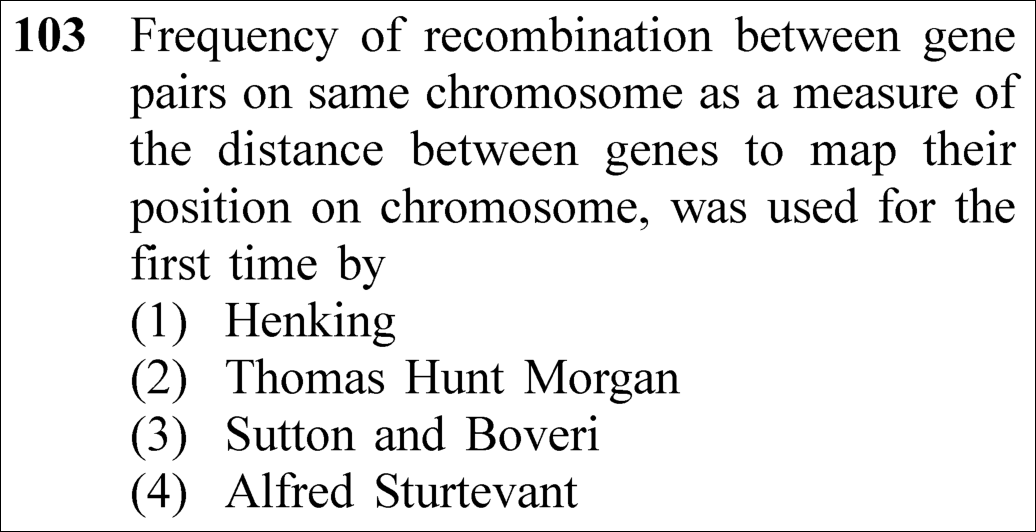
NEET 2023 Botany Question 103: Genetic Mapping and Recombination Frequency

Question

Frequency of recombination between gene pairs on same chromosome as a measure of the distance between genes to map their position on chromosome, was used for the first time by

  1. (1)Henking
  2. (2)Thomas Hunt Morgan
  3. (3)Sutton and Boveri
  4. (4)Alfred Sturtevant
✓
Verified Against NTA Final Answer Key
Option (4) : Alfred Sturtevant
📚 Principles of Inheritance and Variation Easy
📋 Given Parameters & Problem Setup
Genetic Concept Chromosome mapping using recombination frequency
Relationship 1% recombination = 1 map unit (centiMorgan)
⚡

The 30-Second Exam Hall Shortcut: ⚡ Student of Morgan Anchor: Sturtevant = Genetic Maps

⏱️ Save ~20 seconds

T.H. Morgan established sex linkage and recombination in Drosophila, but it was his brilliant undergraduate student Alfred Sturtevant who first used recombination frequency to construct chromosome genetic maps!

1 Henking discovered the X-body in insects.
2 Sutton and Boveri formulated the Chromosomal Theory of Inheritance.
3 T.H. Morgan conducted experimental verification of linkage.
4 Alfred Sturtevant utilized recombination frequencies to generate genetic maps.
5 Match Option (4) directly.
🛡️
Why You Can 100% Trust This Shortcut: Canonical NCERT Genetics historical discovery chronology.
📐

Step-by-Step Rigorous Workflow & Mathematical Proof

Step 1

Concept of Genetic Mapping

Alfred Sturtevant (1913), a student of Thomas Hunt Morgan, reasoned that the frequency of recombination between two linked gene pairs is proportional to the physical distance separating them on the chromosome:

Map Distance (cM)=Recombination Frequency (%)=Total Recombinant OffspringTotal Offspring×100\text{Map Distance (cM)} = \text{Recombination Frequency (\%)} = \frac{\text{Total Recombinant Offspring}}{\text{Total Offspring}} \times 100
Step 2

Historical Attribution of Related Genetic Discoveries

Key genetic milestones in NCERT include:

Henking (1891):Observed X-body in insect spermatogenesisSutton & Boveri (1902):Chromosomal Theory of InheritanceT. H. Morgan (1910):Experimental proof of linkage in DrosophilaAlfred Sturtevant (1913):First chromosome map using recombination frequencies\begin{aligned} \text{Henking (1891):} & \quad \text{Observed X-body in insect spermatogenesis} \\[3pt] \text{Sutton \& Boveri (1902):} & \quad \text{Chromosomal Theory of Inheritance} \\[3pt] \text{T. H. Morgan (1910):} & \quad \text{Experimental proof of linkage in } \textit{Drosophila} \\[3pt] \text{\textbf{Alfred Sturtevant (1913):}} & \quad \text{\textbf{First chromosome map using recombination frequencies}} \end{aligned}
Step 3

Modern Significance

Sturtevant's genetic mapping principle served as the foundation for modern genome sequencing projects, including the Human Genome Project.

⭐

360° Option Elimination Engine Key Feature

Diagnose every choice: Know exactly why the right option works and why distractors fail.

4-Option Deep Scan
1 1
✗ Incorrect
Verdict & Scientific Reason:

Hermann Henking discovered the nuclear structure termed the "X-body" (X-chromosome) during insect spermatogenesis, not gene maps.

⚠️
Student Fallacy (Why candidates pick this trap): Confusing chromosome discovery with gene mapping.
2 2
✗ Incorrect
Verdict & Scientific Reason:

Morgan discovered linkage and crossing over, but his student Sturtevant constructed the first genetic map.

⚠️
Student Fallacy (Why candidates pick this trap): Attribute all Drosophila linkage discoveries to lab head Morgan instead of student Sturtevant.
3 3
✗ Incorrect
Verdict & Scientific Reason:

Walter Sutton and Theodor Boveri proposed the Chromosomal Theory of Inheritance by correlating Mendelian factors with chromosome segregation.

⚠️
Student Fallacy (Why candidates pick this trap): Confusing chromosomal theory with genetic distance measurement.
4 4
✓ 100% Correct
Verdict & Scientific Reason:

Alfred Sturtevant utilized recombination frequency as a measure of genetic distance to map gene positions on chromosomes.

💡
Why this is airtight: None; verbatim textbook fact.
⚠️

NTA Trap Alert: Morgan vs. Sturtevant Trap

Because T.H. Morgan is the father of experimental genetics, students impulsively select Morgan without reading the specific mention of chromosome mapping.

🛡️ How to avoid the -1 mark: Remember: Linkage = Morgan; Gene Mapping = Sturtevant.
📖

Core NEET Syllabus Standard

NCERT Biology · Principles of Inheritance and Variation Standard Benchmark
Core Scientific Principle Tested:

"Alfred Sturtevant used the frequency of recombination between gene pairs on the same chromosome as a measure of the distance between genes and mapped their position on the chromosome."

Syllabus Focus: Linkage and Recombination
✓ Core NEET UG Syllabus Anchor Syllabus & Academic Standards ↗

Ready to attempt under real exam pressure?

Test your speed and accuracy in the authentic 200-minute timed NTA simulator.

Launch NEET 2023 CBT Test →

Spotted a mistake in this solution? Report an error ([email protected])

⚖️ Legal & Fair Dealing Notice: Sourced from publicly released NEET 2023 question papers and NEET answer keys for private study, research, and non-commercial educational practice under Fair Dealing (Section 52(1)(a) of the Indian Copyright Act, 1957). Not affiliated with or endorsed by NTA or NMC.

Solve 4 NEET Questions a Day — One per Subject

Cover all 1,140 official NEET questions in 285 days at your own pace. Progress is saved on your device. No login needed.