MyCompetitiveExams Logo MyCompetitiveExams
Search 1,140+ Questions
Chapters, formulas, speed tricks
→
⚡ Brahmastra NEET 2027
720 MARKS

Dynamic 180-question full-length simulator mixed dynamically from all 6 years for 2027 & 2026 aspirants.

Launch Brahmastra 2027 Test →
Start Practice →
100% Free · No Login Required
Q.102 Botany ⭐ 360° Option Elimination Active
Vault ↗

NEET 2023 Botany Question 102 Solution

Topic: Biomolecules · Official NTA Booklet Code G5
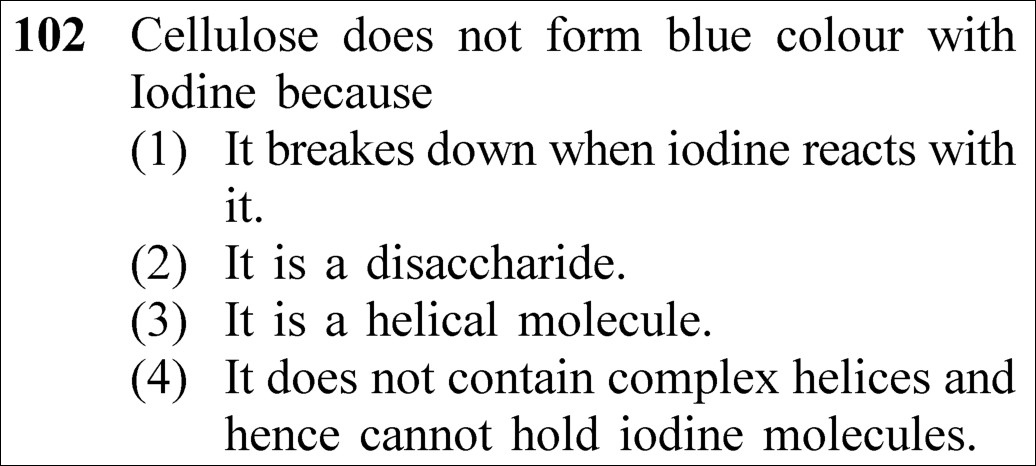
NEET 2023 Botany Question 102: Polysaccharide Architecture and Iodine Reaction

Question

Cellulose does not form blue colour with Iodine because

✓
Verified Against NTA Final Answer Key
Option (4) : It does not contain complex helices and hence cannot hold iodine molecules.
📚 Biomolecules Easy
📋 Given Parameters & Problem Setup
Macromolecule Cellulose (unbranched β-1,4-glucan polymer)
Reagent Iodine solution (I2/KII_2 / KI)
Test Result No blue color formation
⚡

The 30-Second Exam Hall Shortcut: ⚡ Helical Starch vs. Linear Cellulose Trap

⏱️ Save ~20 seconds

Starch forms secondary helical structures that physically trap I2I_2 molecules in their interior coils to give an intense blue color. Cellulose is an unbranched, rigid, linear polymer lacking secondary helices, so it cannot hold iodine!

1 Starch gives blue color with I2I_2 because amylose forms helical coils accommodating polyiodide ions.
2 Cellulose consists of unbranched chains held by hydrogen bonds into linear microfibrils without helical coils.
3 Without helical coils, no iodine entrapment can occur.
4 Option (4) gives this exact conformational explanation.
🛡️
Why You Can 100% Trust This Shortcut: Canonical NCERT Biomolecules structural polysaccharide principle.
📐

Step-by-Step Rigorous Workflow & Mathematical Proof

Step 1

Mechanism of Starch-Iodine Complex

Amylose in starch forms a helical secondary structure with internal hydrophobic cavities:

Amylose (\alpha-1,4-helical)+I2⟶[Starch⋅I5−](inclusion complex)  ⟹  Deep Blue Colour\text{Amylose (\alpha-1,4-helical)} + I_2 \longrightarrow [\text{Starch}\cdot I_5^-]_{(\text{inclusion complex})} \implies \text{\textbf{Deep Blue Colour}}
Step 2

Structural Architecture of Cellulose

Cellulose is a linear, unbranched homopolymer of β\beta-D-glucose linked via β\beta-1,4-glycosidic bonds. Extensive inter- and intramolecular hydrogen bonding holds adjacent chains parallel in planar sheets, preventing helical coil formation:

Cellulose (\beta-1,4-linear)  ⟹  No helical interior  ⟹  Cannot hold I2\text{Cellulose (\beta-1,4-linear)} \implies \text{No helical interior} \implies \text{\textbf{Cannot hold }} I_2
Step 3

Chemical Inertness to Iodine

Because cellulose does not possess the prerequisite helical secondary structure to trap polyiodide ions, it produces a negative result (no blue colouration) upon addition of iodine solution.

⭐

360° Option Elimination Engine Key Feature

Diagnose every choice: Know exactly why the right option works and why distractors fail.

4-Option Deep Scan
1 1
✗ Incorrect
Verdict & Scientific Reason:

Cellulose does not undergo chemical hydrolysis or breakdown upon exposure to dilute iodine.

⚠️
Student Fallacy (Why candidates pick this trap): Assuming a negative visual test implies destruction of the substrate.
2 2
✗ Incorrect
Verdict & Scientific Reason:

Cellulose is a high-molecular-weight homopolysaccharide composed of thousands of glucose units, not a disaccharide.

⚠️
Student Fallacy (Why candidates pick this trap): Confusing cellobiose (disaccharide) with cellulose (polysaccharide).
3 3
✗ Incorrect
Verdict & Scientific Reason:

Cellulose is linear, not helical. Claim contradicts known polysaccharide biophysics.

⚠️
Student Fallacy (Why candidates pick this trap): Misremembering starch characteristics as cellulose characteristics.
4 4
✓ 100% Correct
Verdict & Scientific Reason:

Accurate NCERT biophysical rationale: absence of secondary helical coils prevents entrapment of iodine molecules.

💡
Why this is airtight: None; verbatim textbook statement.
⚠️

NTA Trap Alert: Chemical Reaction vs. Physical Entrapment Trap

Students frequently believe iodine chemically reacts with starch covalently, rather than being physically entrapped inside helical coils.

🛡️ How to avoid the -1 mark: Remember that starch-iodine color is a physical coordination inclusion complex, fully dependent on helical secondary geometry.
📖

Core NEET Syllabus Standard

NCERT Biology · Biomolecules Standard Benchmark
Core Scientific Principle Tested:

"Starch forms helical secondary structures and can hold I2 molecules in the helical portion. Cellulose does not contain complex helices and hence cannot hold I2."

Syllabus Focus: Polysaccharides
✓ Core NEET UG Syllabus Anchor Syllabus & Academic Standards ↗

Ready to attempt under real exam pressure?

Test your speed and accuracy in the authentic 200-minute timed NTA simulator.

Launch NEET 2023 CBT Test →

Spotted a mistake in this solution? Report an error ([email protected])

⚖️ Legal & Fair Dealing Notice: Sourced from publicly released NEET 2023 question papers and NEET answer keys for private study, research, and non-commercial educational practice under Fair Dealing (Section 52(1)(a) of the Indian Copyright Act, 1957). Not affiliated with or endorsed by NTA or NMC.

Solve 4 NEET Questions a Day — One per Subject

Cover all 1,140 official NEET questions in 285 days at your own pace. Progress is saved on your device. No login needed.