MyCompetitiveExams Logo MyCompetitiveExams
Search 1,140+ Questions
Chapters, formulas, speed tricks
→
⚡ Brahmastra NEET 2027
720 MARKS

Dynamic 180-question full-length simulator mixed dynamically from all 6 years for 2027 & 2026 aspirants.

Launch Brahmastra 2027 Test →
Start Practice →
100% Free · No Login Required
Q.50 Chemistry ⭐ 360° Option Elimination Active
Vault ↗

NEET 2026 Chemistry Question 50 Solution

Topic: Biomolecules · Official NTA Booklet Code 50
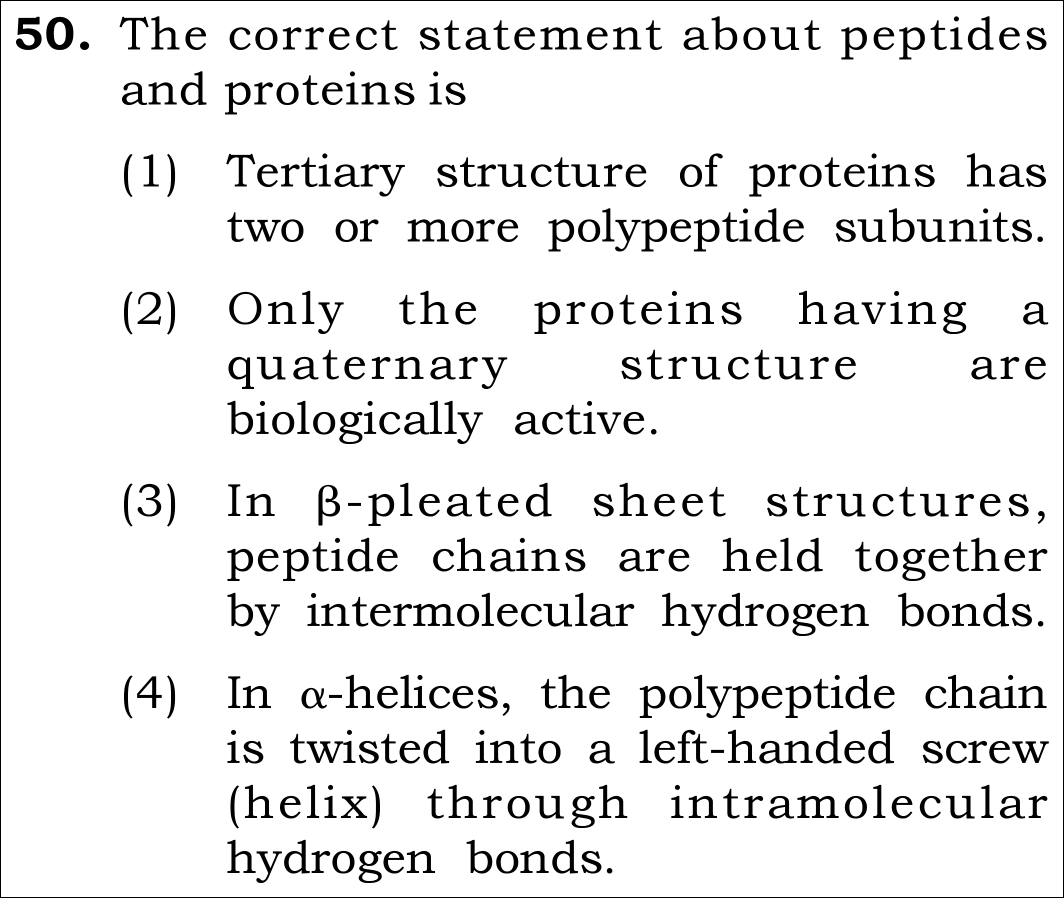
NEET 2026 Chemistry Question 50: Secondary and Tertiary Structural Conformations of Proteins

Question

The correct statement about peptides and proteins is

✓
Verified Against NTA Final Answer Key
Option (3) : In β-pleated sheet structures, peptide chains are held together by intermolecular hydrogen bonds.
📚 Biomolecules Medium
📋 Given Parameters & Problem Setup
Topic Peptides and protein conformational structures
Levels of Structure Primary, Secondary (α-helix, β-sheet), Tertiary, Quaternary
⚡

The 30-Second Exam Hall Shortcut: ⚡ Inter vs Intra Hydrogen Bonding Rule

⏱️ Save ~60 seconds

Alpha-helix = INTRAmolecular H-bonds; Beta-sheet = INTERmolecular H-bonds!

1 Check Statement (1): "Tertiary has two or more subunits" -> FALSE (that is Quaternary structure!).
2 Check Statement (2): "Only quaternary proteins are active" -> FALSE (many monomeric proteins like myoglobin/ribonuclease are biologically active with only tertiary structure).
3 Check Statement (3): "In β-pleated sheets, chains are held by intermolecular hydrogen bonds" -> TRUE (canonical NCERT statement).
4 Check Statement (4): "α-helix is left-handed" -> FALSE (it is strictly right-handed!). Option (3) is locked!
🛡️
Why You Can 100% Trust This Shortcut: Verbatim NCERT Chemistry statement: In the β-pleated sheet structure, all peptide chains are stretched out to nearly maximum extension and then laid side by side, held together by intermolecular hydrogen bonds.
📐

Step-by-Step Rigorous Workflow & Mathematical Proof

Step 1

Evaluate Statement (1): Tertiary Structure Definition

Tertiary structure represents the overall folding of the polypeptide chains (further folding of the secondary structure), giving rise to fibrous or globular shapes. The spatial arrangement of two or more polypeptide subunits with respect to each other is defined as QUATERNARY structure, not tertiary.

Two or more subunits≡Quaternary Structure (e.g., Haemoglobin with 4 chains)\text{Two or more subunits} \equiv \text{Quaternary Structure (e.g., Haemoglobin with 4 chains)}
  • • Statement 1 is incorrect.
Step 2

Evaluate Statement (2): Biological Activity of Proteins

Biological activity does not strictly require quaternary structure. Numerous single-chain globular proteins (such as myoglobin, lysozyme, and ribonuclease) possess only primary, secondary, and tertiary structures and exhibit full native biological activity.

Monomeric Enzymes (Lysozyme, RNase)→tertiary structure onlyFully Biologically Active\text{Monomeric Enzymes (Lysozyme, RNase)} \xrightarrow{\text{tertiary structure only}} \text{Fully Biologically Active}
  • • Statement 2 is incorrect.
Step 3

Evaluate Statement (3): Beta-Pleated Sheet Stabilization

In the β-pleated sheet structure, individual polypeptide strands (extended in a zig-zag arrangement) line up adjacent to one another (either parallel or antiparallel). The backbone >C=O group of one chain forms hydrogen bonds with the >N-H group of an adjacent chain. Because these bonds occur between distinct polypeptide chains (or distinct segments), they are INTERMOLECULAR hydrogen bonds.

>C=O⋯H−N<(Intermolecular Hydrogen Bonding between adjacent strands)>\text{C}=\text{O} \cdots \text{H}-\text{N}< \quad (\text{Intermolecular Hydrogen Bonding between adjacent strands})
  • • Statement 3 is scientifically correct and matches textbook definitions.
Step 4

Evaluate Statement (4): Alpha-Helix Handedness

In an α-helix, a polypeptide chain twists into a coil by forming intramolecular hydrogen bonds between the -NH of each amino acid residue and the >C=O of the fourth residue ahead. The natural helical conformation of proteins composed of L-amino acids is exclusively a RIGHT-HANDED screw, not left-handed.

α-Helix≡Right-handed helix (intramolecular H-bonds)\alpha\text{-Helix} \equiv \text{Right-handed helix (intramolecular H-bonds)}
  • • Statement 4 incorrectly claims a left-handed helix.
⭐

360° Option Elimination Engine Key Feature

Diagnose every choice: Know exactly why the right option works and why distractors fail.

4-Option Deep Scan
1 A
✗ Incorrect
Verdict & Scientific Reason:

Incorrect. Two or more polypeptide subunits describe the quaternary structure of a multi-subunit protein.

⚠️
Student Fallacy (Why candidates pick this trap): Confusing tertiary folding of a single chain with quaternary assembly of subunits.
2 B
✗ Incorrect
Verdict & Scientific Reason:

Incorrect. Many proteins consisting of a single polypeptide chain (e.g. myoglobin) are fully biologically active.

⚠️
Student Fallacy (Why candidates pick this trap): Assuming higher structural complexity is a prerequisite for enzymatic function.
3 C
✓ 100% Correct
Verdict & Scientific Reason:

Scientifically accurate and aligns verbatim with NCERT Chemistry Biomolecules.

💡
Why this is airtight: None; exact description of β-sheet stabilization.
4 D
✗ Incorrect
Verdict & Scientific Reason:

Incorrect. Alpha-helices are right-handed screws due to steric constraints of L-amino acid side chains.

⚠️
Student Fallacy (Why candidates pick this trap): Overlooking the screw chirality (handedness) of the α-helix.
⚠️

NTA Trap Alert: Overlooking Handedness and Inter/Intra Distinctions

Students frequently remember that α-helices have H-bonds, but miss the subtle trap: naturally occurring α-helices are RIGHT-HANDED, not left-handed!

🛡️ How to avoid the -1 mark: Remember the mnemonic: Alpha is Always Right (Right-handed screw with INTRAmolecular bonds); Beta is Beside (sheets laid side-by-side with INTERmolecular bonds).
📖

Core NEET Syllabus Standard

NEET Chemistry Core Syllabus · Biomolecules Standard Benchmark
Core Scientific Principle Tested:

"Secondary structures are stabilized by hydrogen bonding: α-helices are right-handed (intramolecular), while β-pleated sheets are held by intermolecular H-bonds."

Syllabus Focus: Structure and conformation of proteins
✓ Core NEET UG Syllabus Anchor Syllabus & Academic Standards ↗
Beta = Between strands (Intermolecular H-bonds); Alpha = Alone inside (Intramolecular, Right-handed)!

Ready to attempt under real exam pressure?

Test your speed and accuracy in the authentic 180-minute timed NTA simulator.

Launch NEET 2026 CBT Test →

Spotted a mistake in this solution? Report an error ([email protected])

⚖️ Legal & Fair Dealing Notice: Sourced from publicly released NEET 2026 question papers and NEET answer keys for private study, research, and non-commercial educational practice under Fair Dealing (Section 52(1)(a) of the Indian Copyright Act, 1957). Not affiliated with or endorsed by NTA or NMC.

Solve 4 NEET Questions a Day — One per Subject

Cover all 1,140 official NEET questions in 285 days at your own pace. Progress is saved on your device. No login needed.