MyCompetitiveExams Logo MyCompetitiveExams
Search 1,140+ Questions
Chapters, formulas, speed tricks
→
⚡ Brahmastra NEET 2027
720 MARKS

Dynamic 180-question full-length simulator mixed dynamically from all 6 years for 2027 & 2026 aspirants.

Launch Brahmastra 2027 Test →
Start Practice →
100% Free · No Login Required
Q.63 Zoology ⭐ 360° Option Elimination Active
Vault ↗

NEET 2020 Zoology Question 63 Solution

Topic: Sexual Reproduction in Flowering Plants · Official NTA Booklet Code E1
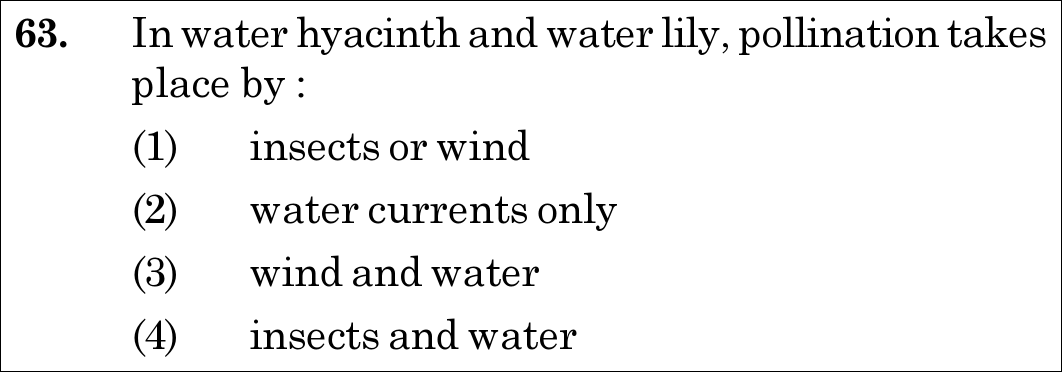
NEET 2020 Zoology Question 63: Pollination in Emergent Aquatic Plants: Water Hyacinth and Water Lily

Question

In water hyacinth and water lily, pollination takes place by:

  1. (1)insects or wind
  2. (2)water currents only
  3. (3)wind and water
  4. (4)insects and water
✓
Verified Against NTA Final Answer Key
Option (1) : insects or wind
📚 Sexual Reproduction in Flowering Plants Easy
📋 Given Parameters & Problem Setup
Plant Species Water hyacinth (Eichhornia crassipes) and Water lily (Nymphaea)
Habitat Aquatic (freshwater)
Question Objective Identify the pollinating agents responsible for pollination
⚡

The 30-Second Exam Hall Shortcut: ⚡ "Water Hyacinth & Water Lily: Emerged Above Water = INSECTS OR WIND, NOT WATER!"

⏱️ 25 seconds

Even though they grow in water, the flowers of water hyacinth and water lily emerge above the level of water and are pollinated by INSECTS OR WIND (anemophily/entomophily), just like land plants! Hydrophily occurs in Vallisneria and Zostera. Mark Option (1) in 5 seconds.

1 Recognize common misconception: Growing in water does NOT mean pollination by water currents!
2 In water hyacinth and water lily, flowers emerge above water surface.
3 They are pollinated by insects or wind as in most land plants.
4 Select Option (1) insects or wind.
🛡️
Why You Can 100% Trust This Shortcut: NCERT Biology · Sexual Reproduction in Flowering Plants (Pollination: Abiotic & Biotic Agents)
📐

Step-by-Step Rigorous Workflow & Mathematical Proof

Step 1

Identify True Aquatic Pollination (Hydrophily)

Pollination by water (hydrophily) is quite rare in flowering plants (limited to about 30 genera, mostly monocotyledons), exemplified by Vallisneria, Hydrilla (freshwater), and Zostera (marine seagrass).

Step 2

Evaluate Water Hyacinth and Water Lily

In a majority of aquatic plants such as water hyacinth (Eichhornia) and water lily (Nymphaea), the flowers emerge above the level of water and are pollinated by insects or wind, just as in most land plants.

Step 3

Scrutinize Floral Adaptations

Water lily and water hyacinth possess conspicuous, colorful, fragrant petals designed to attract insect pollinators (entomophily) or produce wind-borne pollen (anemophily), rendering water currents completely uninvolved in their pollination.

Step 4

Conclude Correct Option

Therefore, pollination takes place by insects or wind (Option 1).

⭐

360° Option Elimination Engine Key Feature

Diagnose every choice: Know exactly why the right option works and why distractors fail.

4-Option Deep Scan
1 A
✓ 100% Correct
Verdict & Scientific Reason:

Factually exact; NCERT verbatim states that in water hyacinth and water lily, flowers emerge above water and are pollinated by insects or wind.

💡
Why this is airtight: None; famous classic botanical exception.
2 B
✗ Incorrect
Verdict & Scientific Reason:

Incorrect; true hydrophily occurs in submerged plants like Vallisneria and Zostera, not emergent water hyacinth/lily.

⚠️
Student Fallacy (Why candidates pick this trap): Assuming every aquatic plant must be pollinated by water.
3 C
✗ Incorrect
Verdict & Scientific Reason:

Incorrect; water currents play no role in pollination of water hyacinth and water lily.

⚠️
Student Fallacy (Why candidates pick this trap): Guessing that water participates in pollination due to the habitat.
4 D
✗ Incorrect
Verdict & Scientific Reason:

Incorrect; water currents do not transport pollen to these elevated aerial flowers.

⚠️
Student Fallacy (Why candidates pick this trap): Combining insect attraction with water transport.
⚠️

NTA Trap Alert: The "Water" in the Plant Name Trap

Students see "Water hyacinth" and "Water lily" and immediately assume water pollination (hydrophily). But their flowers emerge ABOVE water and are pollinated by INSECTS OR WIND!

🛡️ How to avoid the -1 mark: Remember: Water hyacinth & Water lily = Aerial flowers = INSECTS or WIND. Vallisneria & Zostera = WATER!
📖

Core NEET Syllabus Standard

Zoology · Sexual Reproduction in Flowering Plants Standard Benchmark
Core Scientific Principle Tested:

""

Syllabus Focus: Pollination in Emergent Aquatic Plants: Water Hyacinth and Water Lily
✓ Core NEET UG Syllabus Anchor Syllabus & Academic Standards ↗

Ready to attempt under real exam pressure?

Test your speed and accuracy in the authentic 180-minute timed NTA simulator.

Launch NEET 2020 CBT Test →

Spotted a mistake in this solution? Report an error ([email protected])

⚖️ Legal & Fair Dealing Notice: Sourced from publicly released NEET 2020 question papers and NEET answer keys for private study, research, and non-commercial educational practice under Fair Dealing (Section 52(1)(a) of the Indian Copyright Act, 1957). Not affiliated with or endorsed by NTA or NMC.

Solve 4 NEET Questions a Day — One per Subject

Cover all 1,140 official NEET questions in 285 days at your own pace. Progress is saved on your device. No login needed.