MyCompetitiveExams Logo MyCompetitiveExams
Search 1,140+ Questions
Chapters, formulas, speed tricks
→
⚡ Brahmastra NEET 2027
720 MARKS

Dynamic 180-question full-length simulator mixed dynamically from all 6 years for 2027 & 2026 aspirants.

Launch Brahmastra 2027 Test →
Start Practice →
100% Free · No Login Required
Q.100 Chemistry ⭐ 360° Option Elimination Active
Vault ↗

NEET 2020 Chemistry Question 100 Solution

Topic: Alcohols, Phenols and Ethers · Official NTA Booklet Code E1
NEET 2020 Chemistry Question 100: Grignard Reaction with Ketones: Acetone Yields Tertiary Butyl Alcohol

Question

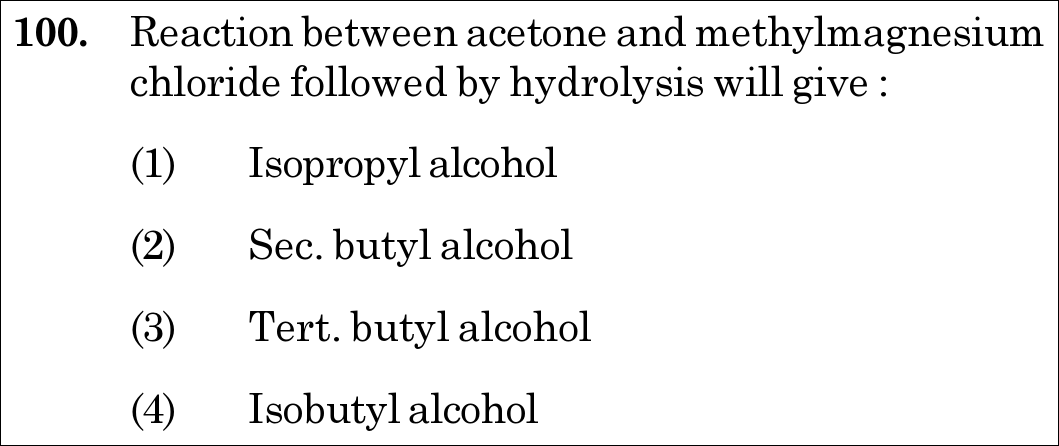
Reaction between acetone and methylmagnesium chloride followed by hydrolysis will give:

  1. (1)Isopropyl alcohol
  2. (2)Sec. butyl alcohol
  3. (3)Tert. butyl alcohol
  4. (4)Isobutyl alcohol
✓
Verified Against NTA Final Answer Key
Option (3) : Tert. butyl alcohol
📚 Alcohols, Phenols and Ethers Easy
📋 Given Parameters & Problem Setup
Substrate Acetone (CH3-CO-CH3, propan-2-one)
Grignard Reagent Methylmagnesium chloride (CH3MgCl)
Second Step Aqueous acid hydrolysis (H3O+)
Question Objective Identify the alcohol produced
⚡

The 30-Second Exam Hall Shortcut: ⚡ "Formaldehyde -> 1° Alcohol; Other Aldehydes -> 2° Alcohol; Ketones -> 3° Alcohol!"

⏱️ 20 seconds

Acetone is a ketone (CH3−CO−CH3CH_3-CO-CH_3). Reaction of any ketone with a Grignard reagent yields a TERTIARY (3°) alcohol upon hydrolysis. Here, acetone (3 carbons) + methyl Grignard (1 carbon) produces 2-methylpropan-2-ol, commonly known as Tertiary Butyl Alcohol (4 carbons)! Mark Tert. butyl alcohol (Option 3) in 5 seconds.

1 Formaldehyde + RMgX -> 1° alcohol.
2 Any other aldehyde + RMgX -> 2° alcohol.
3 Ketone (Acetone) + RMgX -> 3° alcohol.
4 Acetone (CH3COCH3) + CH3MgCl -> (CH3)3C-OMgCl.
5 Hydrolysis with H2O -> (CH3)3C-OH (Tert-butyl alcohol).
6 Select Option (3).
🛡️
Why You Can 100% Trust This Shortcut: NCERT Chemistry · Alcohols, Phenols and Ethers (Preparation of Alcohols: From Grignard Reagents)
📐

Step-by-Step Rigorous Workflow & Mathematical Proof

Step 1

Nucleophilic Addition of Grignard Reagent

The polarized carbon-magnesium bond in methylmagnesium chloride (CH3δ−−MgClδ+\text{CH}_3^{\delta-} - \text{MgCl}^{\delta+}) acts as a strong nucleophile. The carbanion (CH3−\text{CH}_3^-) attacks the electrophilic carbonyl carbon of acetone: CH3−CO−CH3+CH3MgCl→dry ether(CH3)3C-OMgCl\text{CH}_3-\text{CO}-\text{CH}_3 + \text{CH}_3\text{MgCl} \xrightarrow{\text{dry ether}} (\text{CH}_3)_3\text{C-OMgCl} This forms a magnesium alkoxide addition complex.

Step 2

Hydrolysis to Alcohol

Subsequent hydrolysis with water in mildly acidic medium cleaves the oxygen-magnesium bond: (CH3)3C-OMgCl+H2O→(CH3)3C-OH+Mg(OH)Cl(\text{CH}_3)_3\text{C-OMgCl} + \text{H}_2\text{O} \to (\text{CH}_3)_3\text{C-OH} + \text{Mg(OH)Cl} The resulting product is 2-methylpropan-2-ol, whose common IUPAC/trivial name is tertiary butyl alcohol (tert-butyl alcohol).

Step 3

Classification of the Product Alcohol

The hydroxyl (-OH) group is attached to a tertiary carbon that is bonded to three other methyl carbon atoms. Thus, it is an unambiguous 3° alcohol.

Step 4

Eliminate Other Options

Isopropyl alcohol (2-propanol) is a 2° alcohol formed from acetaldehyde + methyl Grignard; sec-butyl alcohol (2-butanol) is formed from propanal + methyl Grignard or acetaldehyde + ethyl Grignard; isobutyl alcohol is a 1° alcohol.

⭐

360° Option Elimination Engine Key Feature

Diagnose every choice: Know exactly why the right option works and why distractors fail.

4-Option Deep Scan
1 A
✗ Incorrect
Verdict & Scientific Reason:

Incorrect; isopropyl alcohol (CH3−CH(OH)−CH3CH_3-CH(OH)-CH_3) has 3 carbons and is formed from acetaldehyde (CH3CHOCH_3CHO) + CH3MgXCH_3MgX, not acetone.

⚠️
Student Fallacy (Why candidates pick this trap): Forgetting that acetone already contains 3 carbons, so adding a methyl group gives 4 carbons.
2 B
✗ Incorrect
Verdict & Scientific Reason:

Incorrect; sec-butyl alcohol (CH3−CH(OH)−CH2−CH3CH_3-CH(OH)-CH_2-CH_3) is a 2° alcohol formed by reacting acetaldehyde with ethyl Grignard.

⚠️
Student Fallacy (Why candidates pick this trap): Confusing 2° butyl alcohol with 3° butyl alcohol.
3 C
✓ 100% Correct
Verdict & Scientific Reason:

Factually and chemically exact; nucleophilic addition of methyl group to acetone followed by protonation gives 2-methylpropan-2-ol (tert-butyl alcohol).

💡
Why this is airtight: None; classic organic synthesis rule.
4 D
✗ Incorrect
Verdict & Scientific Reason:

Incorrect; isobutyl alcohol ((CH3)2CH−CH2OH(CH_3)_2CH-CH_2OH) is a primary alcohol, which cannot be formed from a ketone.

⚠️
Student Fallacy (Why candidates pick this trap): Confusing branched primary alcohol with tertiary alcohol.
⚠️

NTA Trap Alert: Carbon Count & Degree of Alcohol with Grignard

Ketone + Grignard = ALWAYS 3° (Tertiary) alcohol! Acetone has 3 carbons + Grignard has 1 carbon = 4 carbons (Tert-butyl alcohol).

🛡️ How to avoid the -1 mark: Ketone gives TERTIARY alcohol! Acetone gives Tert-butyl alcohol!
📖

Core NEET Syllabus Standard

Chemistry · Alcohols, Phenols and Ethers Standard Benchmark
Core Scientific Principle Tested:

""

Syllabus Focus: Grignard Reaction with Ketones: Acetone Yields Tertiary Butyl Alcohol
✓ Core NEET UG Syllabus Anchor Syllabus & Academic Standards ↗

Ready to attempt under real exam pressure?

Test your speed and accuracy in the authentic 180-minute timed NTA simulator.

Launch NEET 2020 CBT Test →

Spotted a mistake in this solution? Report an error ([email protected])

⚖️ Legal & Fair Dealing Notice: Sourced from publicly released NEET 2020 question papers and NEET answer keys for private study, research, and non-commercial educational practice under Fair Dealing (Section 52(1)(a) of the Indian Copyright Act, 1957). Not affiliated with or endorsed by NTA or NMC.

Solve 4 NEET Questions a Day — One per Subject

Cover all 1,140 official NEET questions in 285 days at your own pace. Progress is saved on your device. No login needed.