MyCompetitiveExams Logo MyCompetitiveExams
Search 1,140+ Questions
Chapters, formulas, speed tricks
→
⚡ Brahmastra NEET 2027
720 MARKS

Dynamic 180-question full-length simulator mixed dynamically from all 6 years for 2027 & 2026 aspirants.

Launch Brahmastra 2027 Test →
Start Practice →
100% Free · No Login Required
Q.29 Botany ⭐ 360° Option Elimination Active
Vault ↗

NEET 2020 Botany Question 29 Solution

Topic: Anatomy of Flowering Plants · Official NTA Booklet Code E1
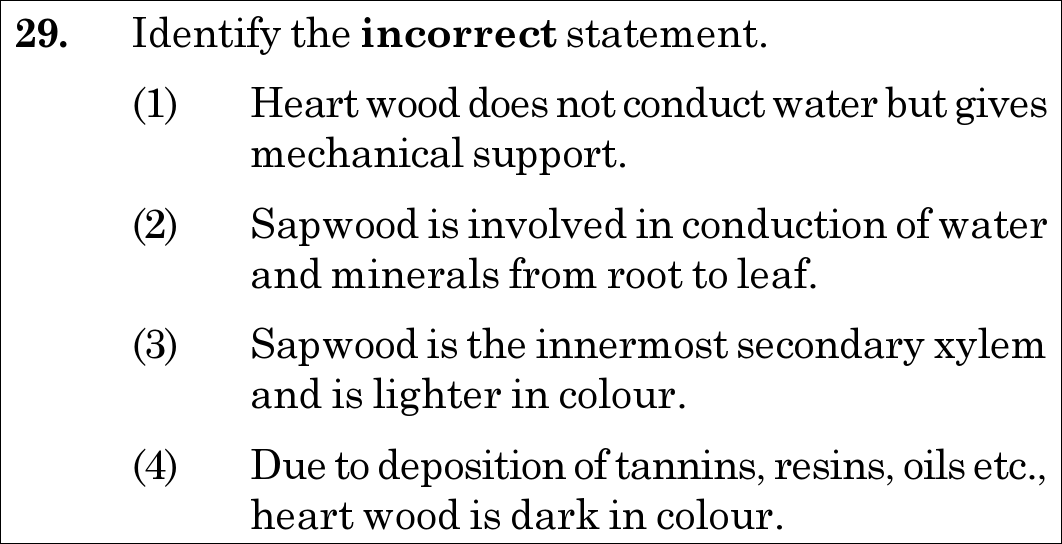
NEET 2020 Botany Question 29: Heartwood (Duramen) vs Sapwood (Alburnum) Anatomy and Position

Question

Identify the incorrect statement.

  1. (1)Heart wood does not conduct water but gives mechanical support.
  2. (2)Sapwood is involved in conduction of water and minerals from root to leaf.
  3. (3)Sapwood is the innermost secondary xylem and is lighter in colour.
  4. (4)Due to deposition of tannins, resins, oils etc., heart wood is dark in colour.
✓
Verified Against NTA Final Answer Key
Option (3) : Sapwood is the innermost secondary xylem and is lighter in colour.
📚 Anatomy of Flowering Plants Easy
📋 Given Parameters & Problem Setup
Tissue Types Heartwood (Duramen) and Sapwood (Alburnum)
Question Objective Identify the INCORRECT statement
⚡

The 30-Second Exam Hall Shortcut: ⚡ "HEARTwood is the INNMOST Dark Wood; SAPwood is the PERIPHERAL Light Wood!"

⏱️ Save ~20 seconds

Heartwood occupies the central innermost core of secondary xylem (dark, dead, plugged with tyloses for mechanical support). Sapwood is the PERIPHERAL (outer) secondary xylem (light-colored, active in water conduction). Claiming sapwood is "innermost" is completely FALSE! Select Option (3).

1 Recall spatial zones of secondary xylem in an old tree trunk: - Innermost central region = Heartwood (Duramen): Non-conducting, dark brown, plugged with gums/resins/tannins, gives mechanical support. - Peripheral outer region = Sapwood (Alburnum): Water-conducting, lighter in colour.
2 Analyze Statement (3): Claims "Sapwood is the innermost secondary xylem" -> Blatantly false!
3 Statement (3) is incorrect and therefore the correct answer.
🛡️
Why You Can 100% Trust This Shortcut: NCERT Biology · Anatomy of Flowering Plants (Secondary Growth - Heartwood and Sapwood: In old trees, the greater part of secondary xylem is dark brown due to deposition of organic compounds... This region comprises dead elements with highly lignified walls and is called heartwood. The peripheral region of the secondary xylem, is lighter in colour and is known as the sapwood. It is involved in the conduction of water and minerals from root to leaf).
📐

Step-by-Step Rigorous Workflow & Mathematical Proof

Step 1

Anatomy and Topography of Secondary Xylem in Old Woody Stems

In arborescent dicotyledonous trees undergoing multi-year secondary growth, the secondary xylem differentiates into two concentric zones: - Heartwood (Duramen): The innermost, central cylinder of secondary xylem. Tracheids and vessels become non-functional and plugged by balloon-like parenchymatous ingrowths called tyloses. Deposition of aromatic tannins, resins, oils, gums, and essential oils imparts a dark brown or black colour, durable decay-resistance, and massive mechanical tensile strength. It does not conduct water. - Sapwood (Alburnum): The peripheral, outer region of secondary xylem. It contains living xylem parenchyma and unobstructed tracheary elements that are actively involved in the conduction of sap (water and dissolved mineral salts) from roots to leaves. It is distinctly lighter in colour.

{Heartwood (Duramen):Innermost central region, Dark, Dead, Mechanical SupportSapwood (Alburnum):Peripheral outer region, Lighter colour, Water Conduction\begin{cases} \textbf{Heartwood (Duramen):} & \mathbf{Innermost\,central\,region}, \, \text{Dark, Dead, Mechanical Support} \\[4pt] \textbf{Sapwood (Alburnum):} & \mathbf{Peripheral\,outer\,region}, \, \text{Lighter colour, Water Conduction} \end{cases}
Step 2

Resolution of the False Statement

Statement (3) claims that sapwood is the "innermost secondary xylem". Because sapwood is strictly peripheral, statement (3) is anatomically false and is the required answer.

⭐

360° Option Elimination Engine Key Feature

Diagnose every choice: Know exactly why the right option works and why distractors fail.

4-Option Deep Scan
1 A
✗ Incorrect
Verdict & Scientific Reason:

This is a true statement. Heartwood vessels are occluded by tyloses and provide structural support.

⚠️
Student Fallacy (Why candidates pick this trap): Assuming heartwood conducts water.
2 B
✗ Incorrect
Verdict & Scientific Reason:

This is a true statement describing the primary physiological role of sapwood.

⚠️
Student Fallacy (Why candidates pick this trap): Confusing sapwood with heartwood.
3 C
✓ 100% Correct
Verdict & Scientific Reason:

Correct as the incorrect statement. Sapwood is the peripheral secondary xylem, not the innermost.

💡
Why this is airtight: None. Direct recall of wood zonal topography.
4 D
✗ Incorrect
Verdict & Scientific Reason:

This is a true statement explaining the dark pigmentation and decay resistance of heartwood.

⚠️
Student Fallacy (Why candidates pick this trap): Failing to realize that organic deposits darken heartwood.
⚠️

NTA Trap Alert: Innermost vs Peripheral Position Inversion Trap

Students frequently remember that sapwood is light and heartwood is dark, but rush past the spatial term: Heartwood is at the "heart" (center/innermost) of the tree; Sapwood is peripheral (outer).

🛡️ How to avoid the -1 mark: Use the anatomical root: The "Heart" of a tree is in the CENTER/INNERMOST -> Heartwood is innermost.
📖

Core NEET Syllabus Standard

NEET / NCERT Biology · Anatomy of Flowering Plants Standard Benchmark
Core Scientific Principle Tested:

"Heartwood is the central/innermost secondary xylem; sapwood is the peripheral conducting secondary xylem."

Syllabus Focus: Heartwood and Sapwood
✓ Core NEET UG Syllabus Anchor Syllabus & Academic Standards ↗

Ready to attempt under real exam pressure?

Test your speed and accuracy in the authentic 180-minute timed NTA simulator.

Launch NEET 2020 CBT Test →

Spotted a mistake in this solution? Report an error ([email protected])

⚖️ Legal & Fair Dealing Notice: Sourced from publicly released NEET 2020 question papers and NEET answer keys for private study, research, and non-commercial educational practice under Fair Dealing (Section 52(1)(a) of the Indian Copyright Act, 1957). Not affiliated with or endorsed by NTA or NMC.

Solve 4 NEET Questions a Day — One per Subject

Cover all 1,140 official NEET questions in 285 days at your own pace. Progress is saved on your device. No login needed.