MyCompetitiveExams Logo MyCompetitiveExams
Search 1,140+ Questions
Chapters, formulas, speed tricks
→
⚡ Brahmastra NEET 2027
720 MARKS

Dynamic 180-question full-length simulator mixed dynamically from all 6 years for 2027 & 2026 aspirants.

Launch Brahmastra 2027 Test →
Start Practice →
100% Free · No Login Required
Q.101 Botany ⭐ 360° Option Elimination Active
Vault ↗

NEET 2024 Botany Question 101 Solution

Topic: Anatomy of Flowering Plants · Official NTA Booklet Code T1
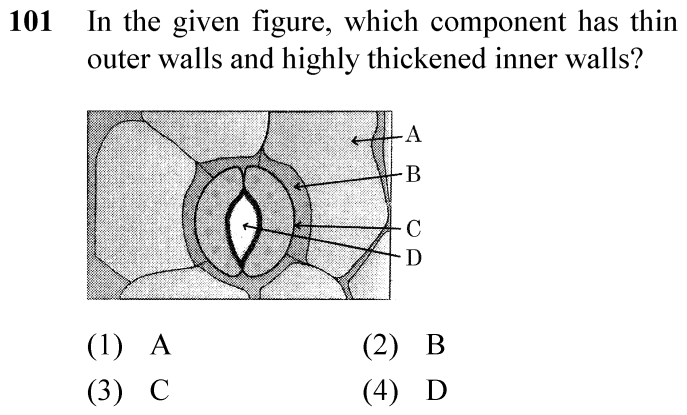
NEET 2024 Botany Question 101: Stomatal Apparatus and Guard Cell Architecture

Question

In the given figure, which component has thin outer walls and highly thickened inner walls?

✓
Verified Against NTA Final Answer Key
Option (3) : Guard cell
📚 Anatomy of Flowering Plants Easy
📋 Given Parameters & Problem Setup
Tissue System Epidermal Tissue System
Structural Feature Thin outer walls and highly thickened inner walls bordering stomatal aperture
⚡

The 30-Second Exam Hall Shortcut: ⚡ Stomatal Wall Asymmetry Rule

⏱️ Save ~20 seconds

Inner wall facing aperture is thick and inelastic; outer wall is thin and elastic. This asymmetric structure belongs uniquely to Guard Cells!

1 Recall stomatal anatomy:
2 - Subsidiary cells: specialized epidermal cells surrounding guard cells, thin-walled.
3 - Epidermal cells: outer protective layer.
4 - Guard cells: kidney/bean-shaped (or dumb-bell in grasses) with thin outer walls and differentially thickened inner walls facing the pore.
5 Differential thickening is essential for opening during turgidity.
6 Hence, the component is the Guard cell -> Option (3) / C.
🛡️
Why You Can 100% Trust This Shortcut: NCERT Biology · Anatomy of Flowering Plants (Epidermal Tissue System and Stomata)
📐

Step-by-Step Rigorous Workflow & Mathematical Proof

Step 1

Understand Stomatal Apparatus Components

The stomatal apparatus consists of the stomatal aperture (pore), two guard cells flanking the pore, and surrounding specialized subsidiary cells derived from epidermal tissue.

Step 2

Analyze Guard Cell Wall Specialization

In dicots, guard cells are bean-shaped or kidney-shaped. The outer walls of guard cells (away from the stomatal pore) are thin, while the inner walls (facing and bordering the stomatal pore) are highly thickened and inelastic. Cellulose microfibrils are oriented radially rather than longitudinally, facilitating aperture opening when guard cells become turgid.

Step 3

Correlate with Given Question

The question asks which component possesses thin outer walls and highly thickened inner walls. This is the hallmark anatomical definition of guard cells.

⭐

360° Option Elimination Engine Key Feature

Diagnose every choice: Know exactly why the right option works and why distractors fail.

4-Option Deep Scan
1 (1)
✗ Incorrect
Verdict & Scientific Reason:

Typical epidermal cells are parenchymatous with a thin layer of cytoplasm lining the cell wall and a large central vacuole, without differential inner/outer wall thickenings.

⚠️
Student Fallacy (Why candidates pick this trap): Typical epidermal cells are parenchymatous with a thin layer of cytoplasm lining the cell wall and a large central vacuole, without differential inner/outer wall thickenings.
2 (2)
✗ Incorrect
Verdict & Scientific Reason:

Subsidiary cells are modified epidermal cells in close proximity to guard cells that provide mechanical and ionic support; they do not possess thickened inner walls.

⚠️
Student Fallacy (Why candidates pick this trap): Subsidiary cells are modified epidermal cells in close proximity to guard cells that provide mechanical and ionic support; they do not possess thickened inner walls.
3 (3)
✓ 100% Correct
Verdict & Scientific Reason:

Guard cells have thin outer walls and highly thickened inner walls bordering the stomatal pore, allowing bowing outward upon turgor increase.

💡
Why this is airtight: None.
4 (4)
✗ Incorrect
Verdict & Scientific Reason:

The stomatal pore is an extracellular aperture/opening, not a cellular component with walls.

⚠️
Student Fallacy (Why candidates pick this trap): The stomatal pore is an extracellular aperture/opening, not a cellular component with walls.
⚠️

NTA Trap Alert: Subsidiary Cell vs Guard Cell Confusion

Students often confuse subsidiary cells with guard cells because both form part of the stomatal apparatus.

🛡️ How to avoid the -1 mark: Remember that only guard cells have chloroplasts and asymmetric wall thickness (thick inner, thin outer) designed for turgor-mediated stomatal movement.
📖

Core NEET Syllabus Standard

Biology Core Botany · Anatomy of Flowering Plants Standard Benchmark
Core Scientific Principle Tested:

"Each stoma is composed of two bean-shaped cells known as guard cells. The outer walls of guard cells (away from the stomatal pore) are thin and the inner walls (towards the stomatal pore) are highly thickened."

Syllabus Focus: Stomatal Apparatus and Guard Cell Architecture
✓ Core NEET UG Syllabus Anchor Syllabus & Academic Standards ↗

Ready to attempt under real exam pressure?

Test your speed and accuracy in the authentic 200-minute timed NTA simulator.

Launch NEET 2024 CBT Test →

Spotted a mistake in this solution? Report an error ([email protected])

⚖️ Legal & Fair Dealing Notice: Sourced from publicly released NEET 2024 question papers and NEET answer keys for private study, research, and non-commercial educational practice under Fair Dealing (Section 52(1)(a) of the Indian Copyright Act, 1957). Not affiliated with or endorsed by NTA or NMC.

Solve 4 NEET Questions a Day — One per Subject

Cover all 1,140 official NEET questions in 285 days at your own pace. Progress is saved on your device. No login needed.