MyCompetitiveExams Logo MyCompetitiveExams
Search 1,140+ Questions
Chapters, formulas, speed tricks
→
⚡ Brahmastra NEET 2027
720 MARKS

Dynamic 180-question full-length simulator mixed dynamically from all 6 years for 2027 & 2026 aspirants.

Launch Brahmastra 2027 Test →
Start Practice →
100% Free · No Login Required
Q.170 Zoology ⭐ 360° Option Elimination Active
Vault ↗

NEET 2026 Zoology Question 170 Solution

Topic: Evolution · Official NTA Booklet Code 50
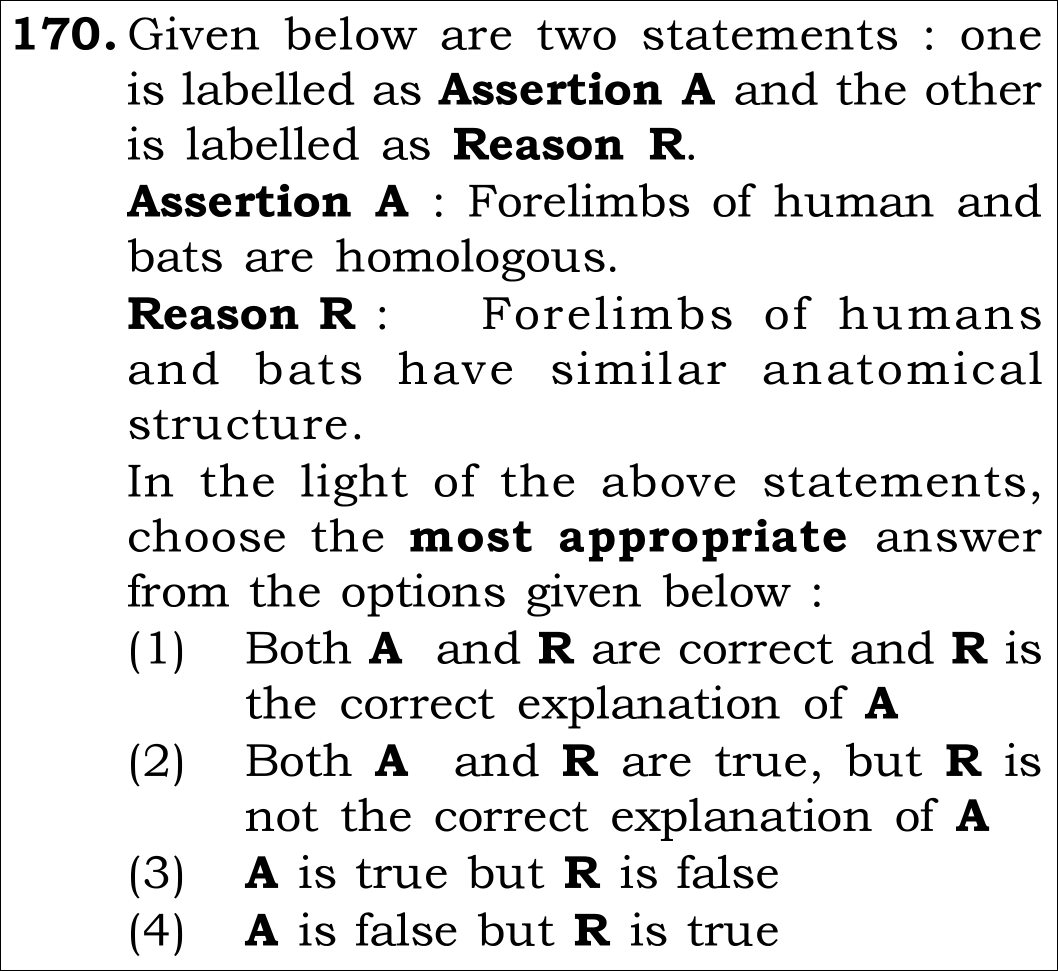
NEET 2026 Zoology Question 170: Homologous Organs & Divergent Evolution of Forelimbs

Question

Given below are two statements: one is labelled as Assertion A and the other is labelled as Reason R. Assertion A: Forelimbs of human and bats are homologous. Reason R: Forelimbs of humans and bats have similar anatomical structure. In the light of the above statements, choose the most appropriate answer from the options given below:

  1. (1)Both A and R are correct and R is the correct explanation of A
  2. (2)Both A and R are true, but R is not the correct explanation of A
  3. (3)A is true but R is false
  4. (4)A is false but R is true
✓
Verified Against NTA Final Answer Key
Option (1) : Both (A) and (R) are true and (R) is the correct explanation of (A)
📚 Evolution Easy
📋 Given Parameters & Problem Setup
Assertion (A) Forelimbs of whales, bats, cheetah, and humans are homologous organs.
Reason (R) They have similar anatomical structure and developmental origin, though they perform different functions.
⚡

The 30-Second Exam Hall Shortcut: ⚡ Homology "Because" Test

⏱️ Save ~40 seconds

They are homologous organs BECAUSE they share the same anatomical plan despite differing functions!

1 Read Assertion (A): Forelimbs of whales, bats, cheetah, and humans are homologous -> TRUE (NCERT textbook exemplar).
2 Read Reason (R): They have similar anatomical structure and origin though perform different functions -> TRUE (canonical definition of homology).
3 Apply the "BECAUSE" connector: Forelimbs are homologous organs BECAUSE they possess the same basic pentadactyl skeletal blueprint (humerus, radius, ulna, carpals, metacarpals, phalanges) inherited from a common ancestor, modified for diverse functions (swimming, flying, running, grasping).
4 Reason (R) is the direct, correct explanation for Assertion (A).
5 Select Option (1) immediately.
🛡️
Why You Can 100% Trust This Shortcut: NCERT Biology · Evolution (Embryological Support for Evolution: Ernst Haeckel biogenetic law refuted by Karl Ernst von Baer).
📐

Step-by-Step Rigorous Workflow & Mathematical Proof

Step 1

Evaluate Assertion (A)

Whales, bats, cheetah, and humans (all mammals) share similarities in the pattern of bones of forelimbs. Though these forelimbs perform different functions (whale for swimming, bat for flying, cheetah for running, human for grasping), they are homologous organs showing divergent evolution.

Forelimbs of Whale, Bat, Cheetah, Human≡Homologous Organs (Divergent Evolution)\text{Forelimbs of Whale, Bat, Cheetah, Human} \equiv \text{Homologous Organs (Divergent Evolution)}
  • • Assertion (A) is completely true.
Step 2

Evaluate Reason (R) and Explanatory Link

Homology is defined as structural similarity due to common ancestry and developmental origin, even if adapted to different functions in different habitats. Because these mammalian forelimbs share the exact same skeletal elements (humerus, radius, ulna, carpals, metacarpals, and phalanges), Reason (R) is true and perfectly explains Assertion (A).

Same Anatomy (Humerus, Radius, Ulna)+Different Functions≡Homology  ⟹  (R) explains (A)\text{Same Anatomy (Humerus, Radius, Ulna)} + \text{Different Functions} \equiv \mathbf{Homology} \implies (R) \text{ explains } (A)
  • • Analogy, in contrast, represents different structures evolving for the same function (convergent evolution).
⭐

360° Option Elimination Engine Key Feature

Diagnose every choice: Know exactly why the right option works and why distractors fail.

4-Option Deep Scan
1 A
✓ 100% Correct
Verdict & Scientific Reason:

100% correct. Reason (R) is the textbook definition of homology and directly explains why mammalian forelimbs are classified as homologous.

💡
Why this is airtight: None; quintessential assertion-reason question.
2 B
✗ Incorrect
Verdict & Scientific Reason:

Incorrect. (R) is the precise scientific justification for (A).

⚠️
Student Fallacy (Why candidates pick this trap): Failing to see that shared developmental anatomy is the core reason for homology.
3 C
✗ Incorrect
Verdict & Scientific Reason:

Incorrect. Reason (R) is factually accurate.

⚠️
Student Fallacy (Why candidates pick this trap): Doubting the anatomical homology of mammals.
4 D
✗ Incorrect
Verdict & Scientific Reason:

Incorrect. Assertion (A) is the classic NCERT example of homologous organs.

⚠️
Student Fallacy (Why candidates pick this trap): Confusing homology with analogy.
⚠️

NTA Trap Alert: Homologous vs. Analogous Organ Inversion

Students sometimes think that because whale forelimbs (flippers) and bat forelimbs (wings) have completely different uses, they must be "analogous". Analogy means same function, different anatomy; Homology means same anatomy, different function.

🛡️ How to avoid the -1 mark: Remember: HOMO-logy = SAME origin/anatomy; ANA-logy = SAME function.
📖

Core NEET Syllabus Standard

NEET Biology Core Syllabus · Evolution Standard Benchmark
Core Scientific Principle Tested:

"Homologous structures share similar anatomical origin and structure adapted for different functions, indicating divergent evolution."

Syllabus Focus: Homology and Analogy
✓ Core NEET UG Syllabus Anchor Syllabus & Academic Standards ↗
Homologous = Heritage (Same bones, different jobs)!

Ready to attempt under real exam pressure?

Test your speed and accuracy in the authentic 180-minute timed NTA simulator.

Launch NEET 2026 CBT Test →

Spotted a mistake in this solution? Report an error ([email protected])

⚖️ Legal & Fair Dealing Notice: Sourced from publicly released NEET 2026 question papers and NEET answer keys for private study, research, and non-commercial educational practice under Fair Dealing (Section 52(1)(a) of the Indian Copyright Act, 1957). Not affiliated with or endorsed by NTA or NMC.

Solve 4 NEET Questions a Day — One per Subject

Cover all 1,140 official NEET questions in 285 days at your own pace. Progress is saved on your device. No login needed.