MyCompetitiveExams Logo MyCompetitiveExams
Search 1,140+ Questions
Chapters, formulas, speed tricks
→
⚡ Brahmastra NEET 2027
720 MARKS

Dynamic 180-question full-length simulator mixed dynamically from all 6 years for 2027 & 2026 aspirants.

Launch Brahmastra 2027 Test →
Start Practice →
100% Free · No Login Required
Q.84 Chemistry · Section A ⭐ 360° Option Elimination Active
Vault ↗

NEET 2024 Chemistry Question 84 Solution

Topic: Thermodynamics · Official NTA Booklet Code T1
NEET 2024 Chemistry Question 84: Prediction of Sign of Entropy Change (ΔS) in Physical and Chemical Processes

Question

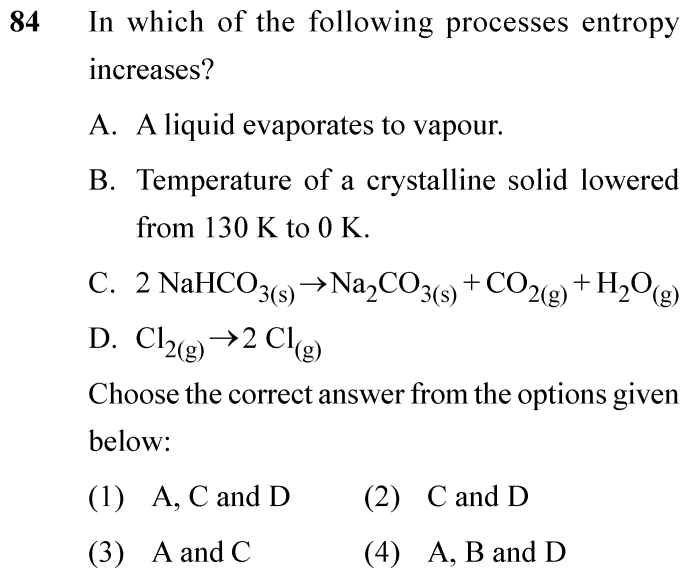
In which of the following processes entropy increases? A. A liquid evaporates to vapour. B. Temperature of a crystalline solid lowered from 130 K to 0 K. C. 2NaHCO₃(s) → Na₂CO₃(s) + CO₂(g) + H₂O(g) D. Cl₂(g) → 2Cl(g) Choose the correct answer from the options given below:

✓
Verified Against NTA Final Answer Key
Option (1) : A, C and D
📚 Thermodynamics Easy
📋 Given Parameters & Problem Setup
Process A A liquid evaporates to vapour
Process B Temperature of a crystalline solid lowered from 130 K to 0 K
Process C 2 NaHCO3(s) -> Na2CO3(s) + CO2(g) + H2O(g)
Process D Cl2(g) -> 2 Cl(g)
⚡

The 30-Second Exam Hall Shortcut: ⚡ Gas Formation & Disorder Rules for Entropy

⏱️ Save ~35 seconds

More gas / higher randomness = ΔS > 0! Liquid to gas (A: ΔS>0); Cooling to absolute zero (B: ΔS<0); Solid producing 2 gas moles (C: ΔS>0); Dissociation 1 mol -> 2 mol gas (D: ΔS>0) -> A, C, and D!

1 Entropy measures degree of disorder and microscopic randomness.
2 Process A: Liquid -> Vapour. Gas phase has vastly higher translational entropy -> ΔS > 0 (Entropy INCREASES).
3 Process B: Cooling from 130 K to 0 K reduces thermal motion and vibrational states, reaching perfect order at 0 K by Third Law -> ΔS < 0 (Entropy DECREASES).
4 Process C: 2 NaHCO3(s) -> Na2CO3(s) + CO2(g) + H2O(g). Reactants have 0 moles of gas; products generate 2 moles of gas -> Δn_g = +2 -> ΔS > 0 (Entropy INCREASES).
5 Process D: Cl2(g) -> 2 Cl(g). Dissociation of 1 diatomic molecule into 2 individual atoms doubles particles -> ΔS > 0 (Entropy INCREASES).
6 Processes with entropy increase are A, C, and D -> Option (1) in 5 seconds!
🛡️
Why You Can 100% Trust This Shortcut: NCERT Chemistry · Thermodynamics (Entropy concept and predicting sign of entropy change in physical transitions and chemical reactions).
📐

Step-by-Step Rigorous Workflow & Mathematical Proof

Step 1

Thermodynamic Definition of Entropy Change

Entropy S is a state function that quantifies the number of accessible microstates (disorder/randomness) of a system. For any process: - Transition from ordered to disordered phase increases entropy (ΔS > 0). - An increase in the number of gaseous molecules increases entropy (Δng > 0 ⟹ ΔS > 0). - Cooling a substance decreases thermal energy and accessible states (ΔS < 0).

ΔS=Sfinal−Sinitial=kBln⁡(ΩfinalΩinitial)\Delta S = S_{\text{final}} - S_{\text{initial}} = k_B \ln\left(\frac{\Omega_{\text{final}}}{\Omega_{\text{initial}}}\right)
Step 2

Stepwise Analysis of the Four Processes

Analyzing each process individually: - A: Evaporation: Molecules in vapour move freely in 3D space with much higher entropy than in the condensed liquid: ΔS_vap > 0. - B: Cooling crystalline solid: As T drops from 130 K to 0 K, atomic vibrations cease. By the Third Law, S approaches 0 at absolute zero: ΔS < 0. - C: Decomposition: 2 NaHCO3(s) ⟶ Na2CO3(s) + CO2(g) + H2O(g). Formation of 2 moles of gaseous products from a solid creates enormous spatial disorder: ΔS > 0. - D: Homolytic dissociation: Cl2(g) ⟶ 2 Cl(g). A single bound diatomic molecule dissociates into two independent free particles: ΔS > 0.

ΔSA>0,ΔSB<0,ΔSC>0,ΔSD>0\Delta S_A > 0, \quad \Delta S_B < 0, \quad \Delta S_C > 0, \quad \Delta S_D > 0
Step 3

Conclusion

Processes in which entropy increases are A, C, and D. This corresponds precisely to Option (1).

Entropy increases in: A, C and D (Option 1)\text{Entropy increases in: A, C and D (Option 1)}
⭐

360° Option Elimination Engine Key Feature

Diagnose every choice: Know exactly why the right option works and why distractors fail.

4-Option Deep Scan
1 (1)
✓ 100% Correct
Verdict & Scientific Reason:

A (vaporization), C (gas evolution), and D (molecular dissociation) all increase disorder.

💡
Why this is airtight: None.
2 (2)
✗ Incorrect
Verdict & Scientific Reason:

Omits vaporization of a liquid (A), which is the most classic entropy-increasing process.

⚠️
Student Fallacy (Why candidates pick this trap): Overlooking phase changes.
3 (3)
✗ Incorrect
Verdict & Scientific Reason:

Omits Cl2 dissociation (D), which doubles the number of gas particles.

⚠️
Student Fallacy (Why candidates pick this trap): Failing to recognize that bond breaking increases entropy.
4 (4)
✗ Incorrect
Verdict & Scientific Reason:

Includes B, where cooling decreases entropy.

⚠️
Student Fallacy (Why candidates pick this trap): Thinking cooling increases entropy.
⚠️

NTA Trap Alert: Including Process B (Cooling to 0 K)

Students sometimes think zero Kelvin means "maximum freedom". In reality, the Third Law of Thermodynamics states that at absolute zero, a perfect crystal has ZERO entropy (minimum possible disorder). Cooling always decreases entropy!

🛡️ How to avoid the -1 mark: Cooling = Freezing motion = Decreasing entropy (ΔS < 0).
📖

Core NEET Syllabus Standard

Chemistry Core Physical Chemistry · Thermodynamics Standard Benchmark
Core Scientific Principle Tested:

"Entropy increases during vaporization, gas-producing decomposition, and dissociation of molecules into atoms; it decreases upon cooling."

Syllabus Focus: Spontaneity: Entropy and the Second and Third Laws of Thermodynamics
✓ Core NEET UG Syllabus Anchor Syllabus & Academic Standards ↗
Boiling, breaking, producing gas: entropy grows in a massive mass (A, C, D)!

Ready to attempt under real exam pressure?

Test your speed and accuracy in the authentic 200-minute timed NTA simulator.

Launch NEET 2024 CBT Test →

Spotted a mistake in this solution? Report an error ([email protected])

⚖️ Legal & Fair Dealing Notice: Sourced from publicly released NEET 2024 question papers and NEET answer keys for private study, research, and non-commercial educational practice under Fair Dealing (Section 52(1)(a) of the Indian Copyright Act, 1957). Not affiliated with or endorsed by NTA or NMC.

Solve 4 NEET Questions a Day — One per Subject

Cover all 1,140 official NEET questions in 285 days at your own pace. Progress is saved on your device. No login needed.