MyCompetitiveExams Logo MyCompetitiveExams
Search 1,140+ Questions
Chapters, formulas, speed tricks
→
⚡ Brahmastra NEET 2027
720 MARKS

Dynamic 180-question full-length simulator mixed dynamically from all 6 years for 2027 & 2026 aspirants.

Launch Brahmastra 2027 Test →
Start Practice →
100% Free · No Login Required
Q.62 Chemistry · Section A ⭐ 360° Option Elimination Active
Vault ↗

NEET 2024 Chemistry Question 62 Solution

Topic: Biomolecules · Official NTA Booklet Code T1
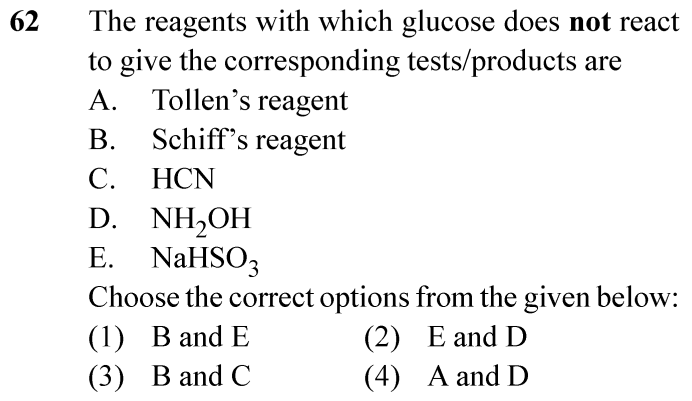
NEET 2024 Chemistry Question 62: Cyclic Hemiacetal Structure of Glucose and Anomalous Reactions

Question

The reagents with which glucose does not react to give the corresponding tests/products are A. Tollen's reagent B. Schiff's reagent C. HCN D. NH₂OH E. NaHSO₃ Choose the correct options from the given below:

✓
Verified Against NTA Final Answer Key
Option (1) : B and E (Schiff’s reagent and NaHSO3)
📚 Biomolecules Easy
📋 Given Parameters & Problem Setup
Target molecule D-Glucose (C6H12O6)
Condition Reagents with which glucose does NOT react to give corresponding tests/products
⚡

The 30-Second Exam Hall Shortcut: ⚡ Cyclic Glucopyranose Masked Aldehyde Hack

⏱️ Save ~40 seconds

Glucose forms an oxime (NH2OH) and cyanohydrin (HCN), reduces Tollen’s, but FAILS Schiff’s test and does NOT form NaHSO3 adduct because the -CHO group is locked in a cyclic hemiacetal ring!

1 D-Glucose exists predominantly (>99.5%) in cyclic α- and β-glucopyranose hemiacetal forms.
2 The open-chain aldehyde form exists in minute equilibrium concentrations.
3 Strong nucleophiles (HCN, NH2OH) and oxidizing agents (Tollen’s reagent) shift the ring-chain equilibrium and react successfully.
4 Weakly nucleophilic reagents such as Schiff’s reagent and bulky sodium bisulphite (NaHSO3) CANNOT react with the cyclic hemiacetal.
5 Therefore, glucose does NOT react with Schiff’s reagent (B) and NaHSO3 (E).
6 Option (1) in 5 seconds!
🛡️
Why You Can 100% Trust This Shortcut: NCERT Chemistry · Biomolecules (Evidence for the cyclic structure of glucose: failure to react with Schiff’s reagent and NaHSO3).
📐

Step-by-Step Rigorous Workflow & Mathematical Proof

Step 1

Evidence for the Cyclic Structure of Glucose

Although glucose contains an aldehyde carbonyl group in its Fischer projection, it fails to exhibit several characteristic reactions of aliphatic aldehydes: 1. It does not react with Schiff’s reagent to restore the pink/magenta color. 2. It does not form a sodium bisulphite addition product with NaHSO3. 3. The pentaacetate of glucose does not react with hydroxylamine (NH2OH), proving the absence of a free -CHO group.

Glucose+Schiff’s Reagent⟶No Reaction (Negative Test)\text{Glucose} + \text{Schiff's Reagent} \longrightarrow \text{No Reaction (Negative Test)}
Step 2

Mechanism of Non-Reactivity with NaHSO3 and Schiff’s Reagent

The -OH at C-5 adds intramolecularly to the C-1 carbonyl carbon, locking glucose into a stable six-membered cyclic hemiacetal (glucopyranose). The concentration of free open-chain aldehyde is less than 0.02%. Bulky bisulphite ions (HSO3-) and Schiff’s reagent cannot drive ring opening because their addition products are thermodynamically less stable than the closed hemiacetal ring.

Open-chain aldehyde (0.02%)⇌α- and β-D-Glucopyranose (>99.9%)\text{Open-chain aldehyde (0.02\%)} \xrightleftharpoons{} \alpha\text{- and } \beta\text{-D-Glucopyranose (>99.9\%)}
Step 3

Reactivity with Tollen’s Reagent, HCN, and NH2OH

In contrast: - Tollen’s reagent is alkaline and drives tautomerization (Lobry de Bruyn-Alberda van Ekenstein rearrangement) and oxidation to gluconic acid. - HCN and NH2OH are powerful, unhindered nucleophiles that irreversibly trap the minute open-chain form, pulling the equilibrium forward to completion.

Glucose+HCN→Cyanohydrin;Glucose+NH2OH→Oxime\text{Glucose} + \text{HCN} \rightarrow \text{Cyanohydrin}; \quad \text{Glucose} + \text{NH}_2\text{OH} \rightarrow \text{Oxime}
⭐

360° Option Elimination Engine Key Feature

Diagnose every choice: Know exactly why the right option works and why distractors fail.

4-Option Deep Scan
1 (1)
✓ 100% Correct
Verdict & Scientific Reason:

Verbatim NCERT evidence demonstrating that the -CHO group is tied up in a cyclic hemiacetal.

💡
Why this is airtight: None.
2 (2)
✗ Incorrect
Verdict & Scientific Reason:

Glucose reacts readily with NH2OH to form an oxime.

⚠️
Student Fallacy (Why candidates pick this trap): Believing glucose cannot form an oxime.
3 (3)
✗ Incorrect
Verdict & Scientific Reason:

Glucose reacts with HCN to yield a cyanohydrin.

⚠️
Student Fallacy (Why candidates pick this trap): Thinking cyanohydrin formation fails in glucose.
4 (4)
✗ Incorrect
Verdict & Scientific Reason:

Glucose reduces Tollen’s reagent (silver mirror test) and forms an oxime with NH2OH.

⚠️
Student Fallacy (Why candidates pick this trap): Denying reducing sugar properties of glucose.
⚠️

NTA Trap Alert: Assuming All Aldehyde Tests Work on Glucose

Students who only memorize glucose as an "aldohexose" assume all classic aldehyde tests work. Glucose is a reducing sugar (reduces Tollen’s and Fehling’s), but FAILS Schiff’s and NaHSO3 tests!

🛡️ How to avoid the -1 mark: Memorize the classic pair of failed tests: Schiff’s and NaHSO3.
📖

Core NEET Syllabus Standard

Chemistry Core Biomolecules · Biomolecules Standard Benchmark
Core Scientific Principle Tested:

"Glucose does not give Schiff’s test and does not form an addition product with NaHSO3 because it exists predominantly as a cyclic hemiacetal."

Syllabus Focus: Carbohydrates: Limitations of the Open Chain Structure of Glucose
✓ Core NEET UG Syllabus Anchor Syllabus & Academic Standards ↗
Schiff and Sodium bisulfite say "NO" to the cyclic glucose ring show!

Ready to attempt under real exam pressure?

Test your speed and accuracy in the authentic 200-minute timed NTA simulator.

Launch NEET 2024 CBT Test →

Spotted a mistake in this solution? Report an error ([email protected])

⚖️ Legal & Fair Dealing Notice: Sourced from publicly released NEET 2024 question papers and NEET answer keys for private study, research, and non-commercial educational practice under Fair Dealing (Section 52(1)(a) of the Indian Copyright Act, 1957). Not affiliated with or endorsed by NTA or NMC.

Solve 4 NEET Questions a Day — One per Subject

Cover all 1,140 official NEET questions in 285 days at your own pace. Progress is saved on your device. No login needed.