NEET 2023 Chemistry Question 87 Solution
Question
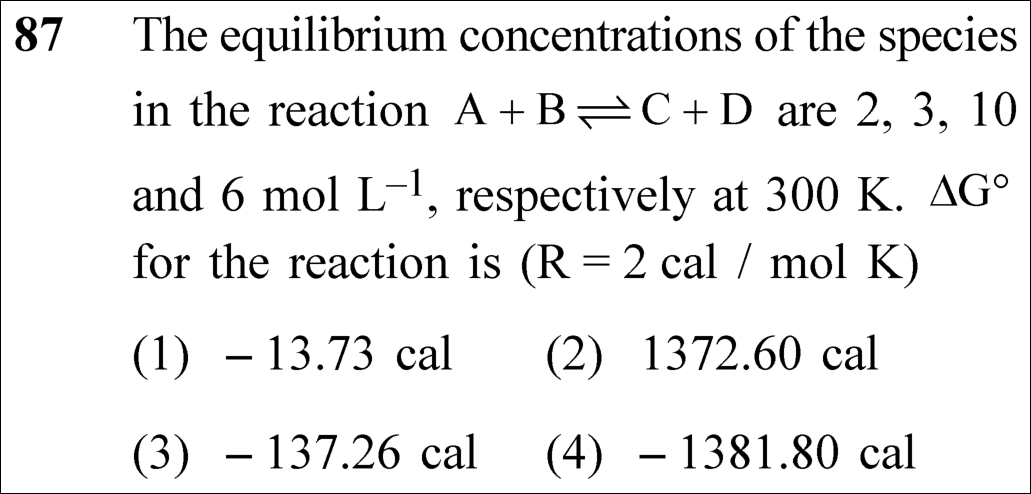
The equilibrium concentrations of the species in the reaction A + B ⇌ C + D are 2, 3, 10 and 6 mol L⁻¹, respectively at 300 K. ΔG° for the reaction is (R = 2 cal/mol K)
Dynamic 180-question full-length simulator mixed dynamically from all 6 years for 2027 & 2026 aspirants.
The equilibrium concentrations of the species in the reaction A + B ⇌ C + D are 2, 3, 10 and 6 mol L⁻¹, respectively at 300 K. ΔG° for the reaction is (R = 2 cal/mol K)
Equilibrium constant Kc = ([C][D])/([A][B]) = (10 × 6)/(2 × 3) = 60/6 = 10. Since log₁₀(10) = 1, ΔG° = -2.303 · R · T · log₁₀(Kc) = -2.303 × 2 × 300 × 1 = -2.303 × 600 = -1381.80 cal in 15 seconds!
For the reversible homogeneous reaction A + B ⇌ C + D, substitute given concentrations:
The standard Gibbs free energy change of reaction is related to the equilibrium constant by:
Given R = 2 cal mol⁻¹ K⁻¹, T = 300 K, and log₁₀(10) = 1:
Diagnose every choice: Know exactly why the right option works and why distractors fail.
Decimal factor error (divided by 100).
Sign error: Omitted the negative sign in ΔG° = -RT ln K.
Decimal factor error (divided by 10).
Accurate: ΔG° = -2.303 × 2 × 300 × 1 = -1381.80 cal.
Two traps lurk here: (1) Forgetting the negative sign in ΔG° = -RT ln K; when Kc > 1, ΔG° MUST be negative. (2) Habitually plugging R = 8.314 J/mol K instead of using R = 2 cal/mol K as explicitly instructed in the prompt.
"Standard Gibbs free energy change dictates the equilibrium position through the relation ΔG° = -2.303 RT log Kc."
Test your speed and accuracy in the authentic 200-minute timed NTA simulator.
Spotted a mistake in this solution? Report an error ([email protected])
Cover all 1,140 official NEET questions in 285 days at your own pace. Progress is saved on your device. No login needed.