MyCompetitiveExams Logo MyCompetitiveExams
Search 1,140+ Questions
Chapters, formulas, speed tricks
→
⚡ Brahmastra NEET 2027
720 MARKS

Dynamic 180-question full-length simulator mixed dynamically from all 6 years for 2027 & 2026 aspirants.

Launch Brahmastra 2027 Test →
Start Practice →
100% Free · No Login Required
Q.70 Chemistry ⭐ 360° Option Elimination Active
Vault ↗

NEET 2023 Chemistry Question 70 Solution

Topic: Chemical Kinetics · Official NTA Booklet Code G5
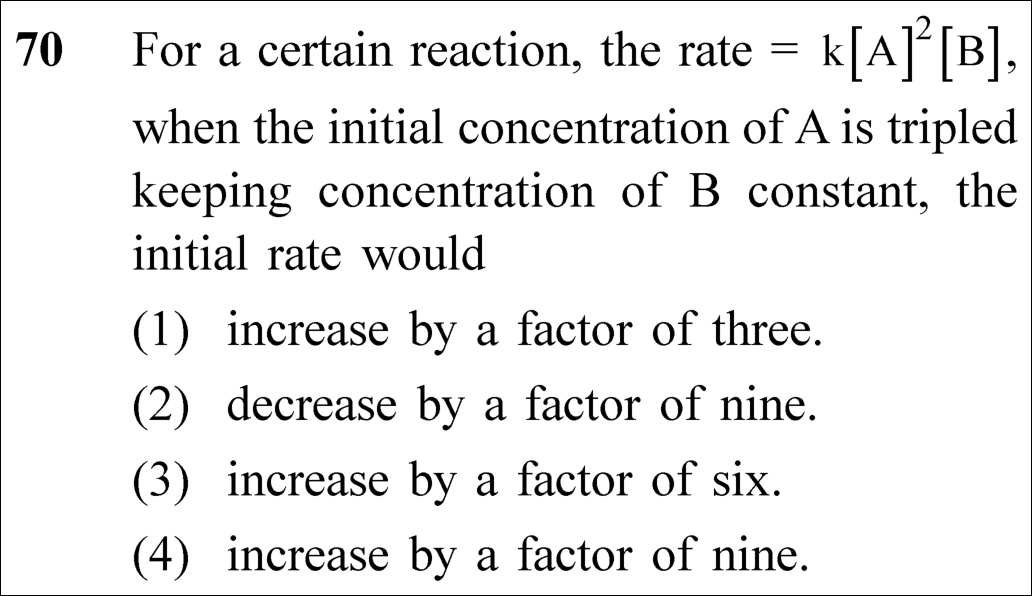
NEET 2023 Chemistry Question 70: Rate Multiplier for Tripled Concentration in Second-Order Component

Question

For a certain reaction, the rate = k[A]²[B], when the initial concentration of A is tripled keeping concentration of B constant, the initial rate would

✓
Verified Against NTA Final Answer Key
Option (4) : increase by a factor of nine.
📚 Chemical Kinetics Easy
📋 Given Parameters & Problem Setup
Differential rate law Rate = k [A]² [B]
Change in [A] [A]' = 3 [A] (tripled)
Change in [B] [B]' = [B] (held constant)
⚡

The 30-Second Exam Hall Shortcut: ⚡ Exponent Scaling Rule: Rate ∝ [A]² ⟹ 3² = 9

⏱️ Save ~25 seconds

The reaction is second-order with respect to A: Rate ∝ [A]². Tripling [A] multiplies the rate by 3² = 9! The initial rate increases by a factor of nine in 5 seconds!

1 Inspect the order with respect to reactant A from the rate law: Rate = k [A]² [B].
2 The exponent on [A] is 2 (second-order with respect to A).
3 When concentration [A] is multiplied by factor 3:
4 Rate' = k (3[A])² [B] = 3² × (k [A]² [B]) = 9 × Rate.
5 The rate increases by a factor of nine.
6 Lock Option (4) increase by a factor of nine immediately!
🛡️
Why You Can 100% Trust This Shortcut: Chemical Kinetics · Rate Law and Reaction Order (For an n-th order reactant, multiplying concentration by factor m scales the rate by mⁿ).
📐

Step-by-Step Rigorous Workflow & Mathematical Proof

Step 1

Initial Rate Formulation

According to the given rate law, the initial rate of reaction r₁ at initial reactant concentrations [A] and [B] is:

r1=k[A]2[B]r_1 = k [A]^2 [B]
Step 2

New Rate Formulation Under Modified Concentration

The initial concentration of A is tripled while [B] remains strictly constant:

[A]′=3[A],[B]′=[B][A]' = 3[A], \qquad [B]' = [B]
Step 3

Substitution into the Rate Law

Substituting the new concentrations into the rate equation gives the new initial rate r₂:

r2=k[A′]2[B′]=k(3[A])2[B]=k(9[A]2)[B]=9(k[A]2[B])r_2 = k [A']^2 [B'] = k (3[A])^2 [B] = k \left(9 [A]^2\right) [B] = 9 \left(k [A]^2 [B]\right)
Step 4

Comparison and Factor Evaluation

Comparing r₂ with r₁:

r2=9 r1  ⟹  The rate increases by a factor of 9r_2 = 9\, r_1 \implies \text{The rate increases by a factor of 9}
⭐

360° Option Elimination Engine Key Feature

Diagnose every choice: Know exactly why the right option works and why distractors fail.

4-Option Deep Scan
1 (1)
✗ Incorrect
Verdict & Scientific Reason:

Linear scaling: assumes first-order with respect to A instead of second-order.

⚠️
Student Fallacy (Why candidates pick this trap): Candidate treated the exponent on [A] as 1 rather than 2.
2 (2)
✗ Incorrect
Verdict & Scientific Reason:

Claims rate decreases despite increasing reactant concentration.

⚠️
Student Fallacy (Why candidates pick this trap): Candidate inverted the rate relationship.
3 (3)
✗ Incorrect
Verdict & Scientific Reason:

Multiplication slip: candidate computed 3 × 2 = 6 instead of 3² = 9.

⚠️
Student Fallacy (Why candidates pick this trap): Candidate multiplied concentration factor by exponent instead of raising to power.
4 (4)
✓ 100% Correct
Verdict & Scientific Reason:

Accurate: Second-order scaling yields 3² = 9 times the initial rate.

💡
Why this is airtight: None. Candidate correctly squared the tripling factor.
⚠️

NTA Trap Alert: Multiplying by the Exponent (3 × 2 = 6) Instead of Raising to Power (3² = 9)

Students who rush through kinetics frequently compute (3 × 2 = 6) and pick Option (3) "increase by a factor of six". The rate law is an exponential power relationship, NOT a linear multiplication!

🛡️ How to avoid the -1 mark: Remember: It is a POWER: (Factor)^Order = 3² = 9, never 3 × 2.
📖

Core NEET Syllabus Standard

National Eligibility cum Entrance Test (NEET UG) · Chemical Kinetics Standard Benchmark
Core Scientific Principle Tested:

"In rate law r = k[A]^x[B]^y, changing [A] by factor m changes rate by m^x."

Syllabus Focus: Rate Law and Order of Reaction
Preserved in Rationalized Curriculum Syllabus & Academic Standards ↗

Ready to attempt under real exam pressure?

Test your speed and accuracy in the authentic 200-minute timed NTA simulator.

Launch NEET 2023 CBT Test →

Spotted a mistake in this solution? Report an error ([email protected])

⚖️ Legal & Fair Dealing Notice: Sourced from publicly released NEET 2023 question papers and NEET answer keys for private study, research, and non-commercial educational practice under Fair Dealing (Section 52(1)(a) of the Indian Copyright Act, 1957). Not affiliated with or endorsed by NTA or NMC.

Solve 4 NEET Questions a Day — One per Subject

Cover all 1,140 official NEET questions in 285 days at your own pace. Progress is saved on your device. No login needed.