MyCompetitiveExams Logo MyCompetitiveExams
Search 1,140+ Questions
Chapters, formulas, speed tricks
→
⚡ Brahmastra NEET 2027
720 MARKS

Dynamic 180-question full-length simulator mixed dynamically from all 6 years for 2027 & 2026 aspirants.

Launch Brahmastra 2027 Test →
Start Practice →
100% Free · No Login Required
Q.139 Botany ⭐ 360° Option Elimination Active
Vault ↗

NEET 2023 Botany Question 139 Solution

Topic: Biomolecules · Official NTA Booklet Code G5
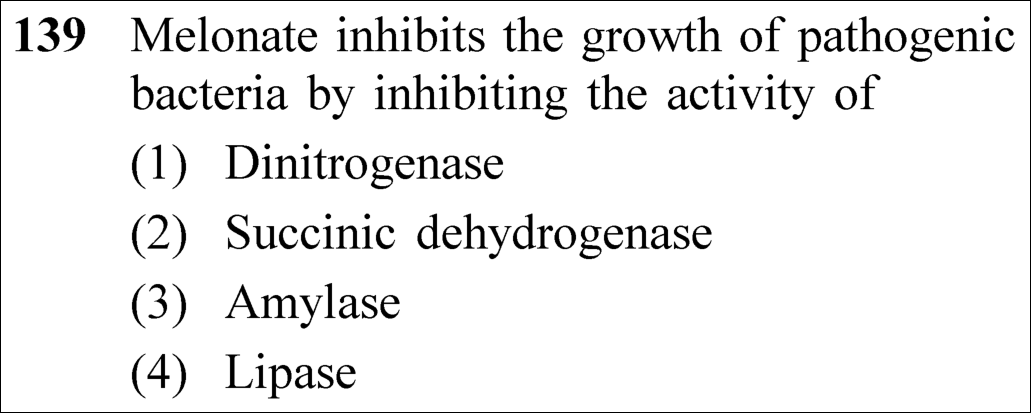
NEET 2023 Botany Question 139: Competitive Enzyme Inhibition: Malonate and Succinic Dehydrogenase

Question

Melonate inhibits the growth of pathogenic bacteria by inhibiting the activity of

  1. (1)Dinitrogenase
  2. (2)Succinic dehydrogenase
  3. (3)Amylase
  4. (4)Lipase
✓
Verified Against NTA Final Answer Key
Option (2) : Succinic dehydrogenase
📚 Biomolecules Easy
📋 Given Parameters & Problem Setup
Inhibitor Malonate (Melonate, structural analogue of succinate)
Biological Role Inhibits bacterial growth via competitive enzyme inhibition
⚡

The 30-Second Exam Hall Shortcut: ⚡ Textbook Competitive Inhibition Classic: Malonate = Succinic Dehydrogenase

⏱️ Save ~20 seconds

The classic NCERT textbook example of competitive enzyme inhibition: Malonate closely resembles the substrate Succinate in structure, competitively inhibiting Succinic Dehydrogenase in the TCA cycle!

1 Substrate: Succinate (HOOC-CH2-CH2-COOH\text{HOOC-CH}_2\text{-CH}_2\text{-COOH}).
2 Competitive inhibitor: Malonate (HOOC-CH2-COOH\text{HOOC-CH}_2\text{-COOH}).
3 Target enzyme: Succinic dehydrogenase.
4 By blocking succinic dehydrogenase, microbial cellular respiration is halted, inhibiting bacterial growth.
5 Match Option (2) Succinic dehydrogenase.
🛡️
Why You Can 100% Trust This Shortcut: Canonical NCERT Biomolecules enzyme kinetics and inhibition prototypes.
📐

Step-by-Step Rigorous Workflow & Mathematical Proof

Step 1

Mechanism of Competitive Enzyme Inhibition

When an inhibitor closely resembles the natural substrate in its molecular structure and competes for the active catalytic site of the enzyme, it is a competitive inhibitor:

Substrate:Succinate (−OOC−CH2−CH2−COO−)Competitive Inhibitor:Malonate (−OOC−CH2−COO−)Target Enzyme:Succinic Dehydrogenase\begin{aligned} \text{Substrate:} & \quad \text{Succinate } (^{-}OOC-CH_2-CH_2-COO^-) \\[3pt] \text{Competitive Inhibitor:} & \quad \text{Malonate } (^{-}OOC-CH_2-COO^-) \\[3pt] \text{Target Enzyme:} & \quad \mathbf{\text{Succinic Dehydrogenase}} \end{aligned}
Step 2

Verbatim NCERT Reference

NCERT states under Enzymes: "Inhibition of succinic dehydrogenase by malonate which closely resembles the substrate succinate in structure. Such competitive inhibitors are often used in the control of bacterial pathogens."

Step 3

Reversibility of Competitive Inhibition

Because the inhibitor binds reversibly to the catalytic active site without altering the enzyme permanently, competitive inhibition can be overcome by increasing substrate concentration (KmK_m increases, Vmax⁡V_{\max} remains unchanged).

⭐

360° Option Elimination Engine Key Feature

Diagnose every choice: Know exactly why the right option works and why distractors fail.

4-Option Deep Scan
1 1
✗ Incorrect
Verdict & Scientific Reason:

Dinitrogenase (nitrogenase) fixes nitrogen into ammonia in diazotrophs; it is poisoned by molecular oxygen, not malonate.

⚠️
Student Fallacy (Why candidates pick this trap): Confusing nitrogen fixation enzymes with Krebs cycle dehydrogenases.
2 2
✓ 100% Correct
Verdict & Scientific Reason:

Exact NCERT prototype of competitive inhibition: malonate inhibits succinic dehydrogenase.

💡
Why this is airtight: None; textbook prototype.
3 3
✗ Incorrect
Verdict & Scientific Reason:

Amylase hydrolyzes alpha-1,4-glycosidic bonds in starch into maltose; it is unrelated to malonate.

⚠️
Student Fallacy (Why candidates pick this trap): Guessing a general digestive enzyme.
4 4
✗ Incorrect
Verdict & Scientific Reason:

Lipase hydrolyzes triglycerides into glycerol and fatty acids, having no interaction with malonate.

⚠️
Student Fallacy (Why candidates pick this trap): Confusing lipid metabolism with respiration.
⚠️

NTA Trap Alert: Spelling Variation Trap ("Melonate" vs. "Malonate")

The NEET question printed "Melonate" instead of "Malonate". Students often hesitate or overthink whether "melonate" is a completely different compound.

🛡️ How to avoid the -1 mark: Recognize standard NEET exam typographical variants: Melonate is the printed variant for Malonate.
📖

Core NEET Syllabus Standard

NCERT Biology · Biomolecules Standard Benchmark
Core Scientific Principle Tested:

"Inhibition of succinic dehydrogenase by malonate which closely resembles the substrate succinate in structure is used in the control of bacterial pathogens."

Syllabus Focus: Enzymes (Factors Affecting Enzyme Activity)
✓ Core NEET UG Syllabus Anchor Syllabus & Academic Standards ↗

Ready to attempt under real exam pressure?

Test your speed and accuracy in the authentic 200-minute timed NTA simulator.

Launch NEET 2023 CBT Test →

Spotted a mistake in this solution? Report an error ([email protected])

⚖️ Legal & Fair Dealing Notice: Sourced from publicly released NEET 2023 question papers and NEET answer keys for private study, research, and non-commercial educational practice under Fair Dealing (Section 52(1)(a) of the Indian Copyright Act, 1957). Not affiliated with or endorsed by NTA or NMC.

Solve 4 NEET Questions a Day — One per Subject

Cover all 1,140 official NEET questions in 285 days at your own pace. Progress is saved on your device. No login needed.