MyCompetitiveExams Logo MyCompetitiveExams
Search 1,140+ Questions
Chapters, formulas, speed tricks
→
⚡ Brahmastra NEET 2027
720 MARKS

Dynamic 180-question full-length simulator mixed dynamically from all 6 years for 2027 & 2026 aspirants.

Launch Brahmastra 2027 Test →
Start Practice →
100% Free · No Login Required
Q.73 Zoology ⭐ 360° Option Elimination Active
Vault ↗

NEET 2020 Zoology Question 73 Solution

Topic: Evolution · Official NTA Booklet Code E1
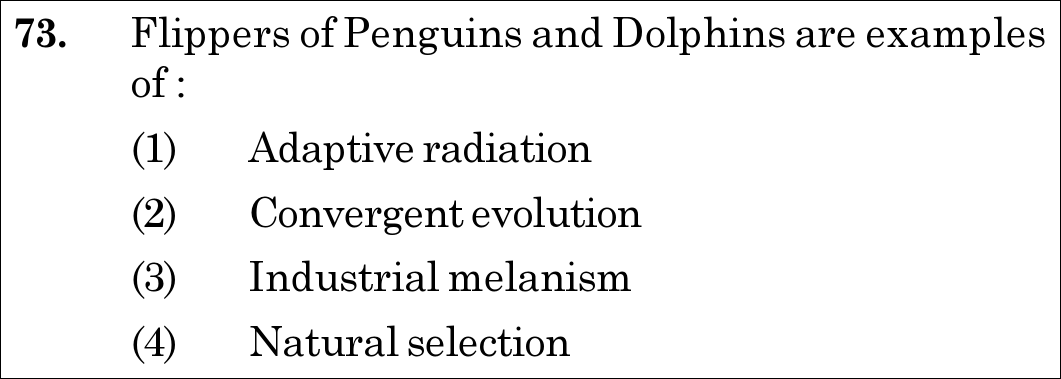
NEET 2020 Zoology Question 73: Analogous Organs: Flippers of Penguins and Dolphins as Convergent Evolution

Question

Flippers of Penguins and Dolphins are examples of:

  1. (1)Adaptive radiation
  2. (2)Convergent evolution
  3. (3)Industrial melanism
  4. (4)Natural selection
✓
Verified Against NTA Final Answer Key
Option (2) : Convergent evolution
📚 Evolution Easy
📋 Given Parameters & Problem Setup
Structures Flippers of Penguins (Birds) and Flippers of Dolphins (Mammals)
Function Swimming in aquatic habitat
Question Objective Identify the evolutionary phenomenon exemplified
⚡

The 30-Second Exam Hall Shortcut: ⚡ "Flippers of Penguin & Dolphin = Analogous Organs = CONVERGENT EVOLUTION!"

⏱️ 20 seconds

Penguins (Aves) and Dolphins (Mammalia) belong to different vertebrate lineages. Their flippers have completely different anatomical structures and embryonic origins, but perform the same function (aquatic locomotion). Different origin + same function = Analogy = Convergent Evolution! Mark Option (2) in 5 seconds.

1 Penguin is a bird; Dolphin is an aquatic mammal.
2 Flippers serve the same swimming function but evolved independently from distinct structural backgrounds.
3 Analogy (different origin, similar function) is the result of Convergent Evolution.
4 Select Option (2) Convergent evolution.
🛡️
Why You Can 100% Trust This Shortcut: NCERT Biology · Evolution (Evidences for Evolution: Homology and Analogy)
📐

Step-by-Step Rigorous Workflow & Mathematical Proof

Step 1

Define Analogy and Convergent Evolution

Organs which are anatomically different in structure and embryonic origin but perform similar functions are called analogous structures. Such similarity arises when different organisms adapt to similar habitats or ecological niches, which is termed convergent evolution.

Step 2

Examine Penguin and Dolphin Flippers

The flippers of penguins (modified wings of birds) and dolphins (modified forelimbs of mammals) are structurally and phylogenetically distinct, yet both function as hydrofoils for swimming in water.

Step 3

NCERT Verbatim Citation

NCERT states explicitly: "Flippers of penguins and dolphins are examples of analogous organs resulting from convergent evolution."

Step 4

Differentiate Other Terms

Adaptive radiation leads to divergent evolution from a common ancestor (e.g. Darwin's finches, mammal forelimbs); industrial melanism is natural selection in Biston betularia.

⭐

360° Option Elimination Engine Key Feature

Diagnose every choice: Know exactly why the right option works and why distractors fail.

4-Option Deep Scan
1 A
✗ Incorrect
Verdict & Scientific Reason:

Incorrect; adaptive radiation involves one ancestral lineage diversifying into many forms with homologous traits (divergent evolution).

⚠️
Student Fallacy (Why candidates pick this trap): Confusing convergent evolution with adaptive radiation.
2 B
✓ 100% Correct
Verdict & Scientific Reason:

Factually exact; unrelated lineages (birds and mammals) independently evolving swimming flippers is a classic case of convergent evolution.

💡
Why this is airtight: None; textbook exemplar of analogy.
3 C
✗ Incorrect
Verdict & Scientific Reason:

Incorrect; industrial melanism describes directional natural selection in the peppered moth (Biston betularia) in response to soot pollution.

⚠️
Student Fallacy (Why candidates pick this trap): Random evolutionary concept.
4 D
✗ Incorrect
Verdict & Scientific Reason:

Incorrect; while natural selection is the broad driving force behind all adaptations, "convergent evolution" is the specific macroevolutionary pattern exemplified by analogous organs.

⚠️
Student Fallacy (Why candidates pick this trap): Selecting an overly broad mechanism instead of the specific anatomical pattern.
⚠️

NTA Trap Alert: Homology vs Analogy Mnemonic

Homology = Divergent evolution (Same origin, different function: Human arm, cheetah leg, bat wing). Analogy = Convergent evolution (Different origin, same function: Penguin & Dolphin flippers, Eye of octopus & mammal).

🛡️ How to avoid the -1 mark: Mnemonic: "H-D, A-C" -> Homology is Divergent; Analogy is Convergent!
📖

Core NEET Syllabus Standard

Zoology · Evolution Standard Benchmark
Core Scientific Principle Tested:

""

Syllabus Focus: Analogous Organs: Flippers of Penguins and Dolphins as Convergent Evolution
✓ Core NEET UG Syllabus Anchor Syllabus & Academic Standards ↗

Ready to attempt under real exam pressure?

Test your speed and accuracy in the authentic 180-minute timed NTA simulator.

Launch NEET 2020 CBT Test →

Spotted a mistake in this solution? Report an error ([email protected])

⚖️ Legal & Fair Dealing Notice: Sourced from publicly released NEET 2020 question papers and NEET answer keys for private study, research, and non-commercial educational practice under Fair Dealing (Section 52(1)(a) of the Indian Copyright Act, 1957). Not affiliated with or endorsed by NTA or NMC.

Solve 4 NEET Questions a Day — One per Subject

Cover all 1,140 official NEET questions in 285 days at your own pace. Progress is saved on your device. No login needed.