MyCompetitiveExams Logo MyCompetitiveExams
Search 1,140+ Questions
Chapters, formulas, speed tricks
→
⚡ Brahmastra NEET 2027
720 MARKS

Dynamic 180-question full-length simulator mixed dynamically from all 6 years for 2027 & 2026 aspirants.

Launch Brahmastra 2027 Test →
Start Practice →
100% Free · No Login Required
Q.169 Physics ⭐ 360° Option Elimination Active
Vault ↗

NEET 2020 Physics Question 169 Solution

Topic: Alternating Current · Official NTA Booklet Code E1
NEET 2020 Physics Question 169: Resonance and Power Factor in a Series LCR Circuit

Question

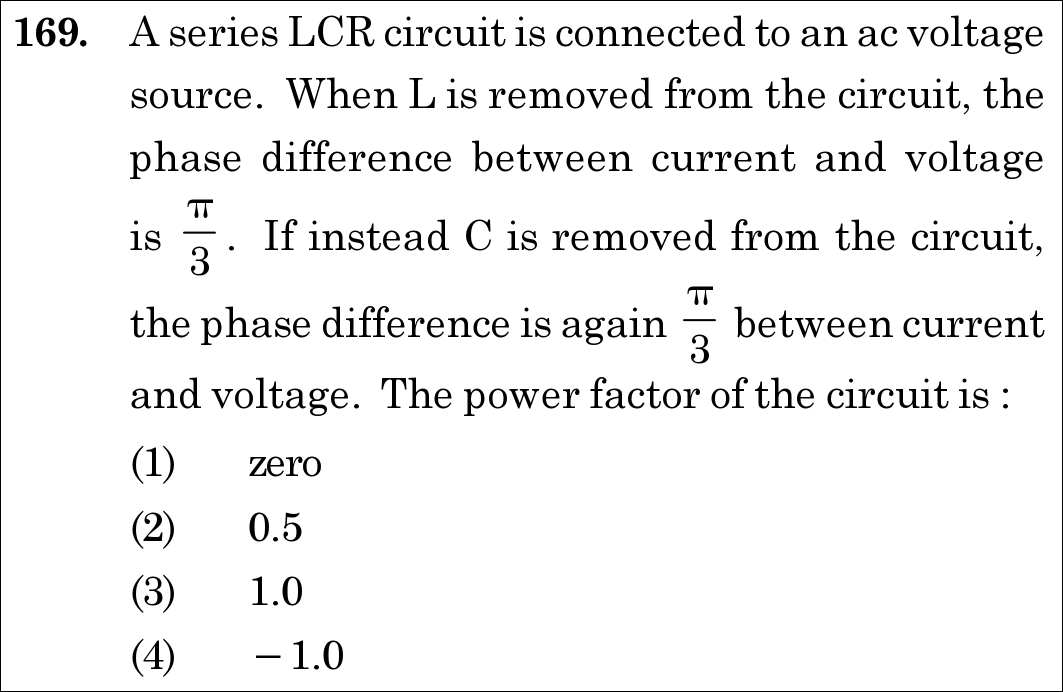
A series LCR circuit is connected to an ac voltage source. When L is removed from the circuit, the phase difference between current and voltage is π/3. If instead C is removed from the circuit, the phase difference is again π/3 between current and voltage. The power factor of the circuit is:

✓
Verified Against NTA Final Answer Key
Option (3) : 1.0
📚 Alternating Current Medium
📋 Given Parameters & Problem Setup
Phase difference without L phi1 = pi/3 (tan phi1 = XC / R)
Phase difference without C phi2 = pi/3 (tan phi2 = XL / R)
⚡

The 30-Second Exam Hall Shortcut: ⚡ "Without L: tan(pi/3) = XC / R. Without C: tan(pi/3) = XL / R. Hence XL = XC => Electrical Resonance! At resonance, Z = R, phi = 0, power factor cos phi = 1.0!"

⏱️ 25 seconds

When removing L leaves a phase difference of π/3, tan(π/3) = XC / R. When removing C leaves the same phase difference of π/3, tan(π/3) = XL / R. This proves XL = XC! In the full series LCR circuit, net reactance X = XL - XC = 0, meaning the circuit is in electrical resonance. Impedance is purely resistive (Z = R), phase angle is 0, and power factor cos(0) = 1.0! Mark Option (3) in 5 seconds flat.

1 Case 1 (without L): tan⁡ϕ=XCR=tan⁡(π/3)=3  ⟹  XC=3R\tan\phi = \frac{X_C}{R} = \tan(\pi/3) = \sqrt{3} \implies X_C = \sqrt{3}R.
2 Case 2 (without C): tan⁡ϕ=XLR=tan⁡(π/3)=3  ⟹  XL=3R\tan\phi = \frac{X_L}{R} = \tan(\pi/3) = \sqrt{3} \implies X_L = \sqrt{3}R.
3 In full LCR circuit: Net reactance X=XL−XC=0X = X_L - X_C = 0.
4 At resonance: ϕ=0  ⟹  Power Factor=cos⁡(0)=1.0\phi = 0 \implies \text{Power Factor} = \cos(0) = 1.0.
5 Select Option (3).
🛡️
Why You Can 100% Trust This Shortcut: NCERT Physics · Alternating Current (Resonance in Series LCR Circuit and Power Factor)
📐

Step-by-Step Rigorous Workflow & Mathematical Proof

Step 1

Analyze Circuit without Inductor L

When LL is removed, the remaining circuit is a series RC circuit. The phase angle between voltage and current is given by: tan⁡ϕ1=XCR\tan\phi_1 = \frac{X_C}{R} Given ϕ1=π3\phi_1 = \frac{\pi}{3}, so: tan⁡(π3)=3=XCR  ⟹  XC=3R\tan\left(\frac{\pi}{3}\right) = \sqrt{3} = \frac{X_C}{R} \implies X_C = \sqrt{3} R.

Step 2

Analyze Circuit without Capacitor C

When CC is removed, the remaining circuit is a series RL circuit. The phase angle is: tan⁡ϕ2=XLR\tan\phi_2 = \frac{X_L}{R} Given ϕ2=π3\phi_2 = \frac{\pi}{3}, so: tan⁡(π3)=3=XLR  ⟹  XL=3R\tan\left(\frac{\pi}{3}\right) = \sqrt{3} = \frac{X_L}{R} \implies X_L = \sqrt{3} R.

Step 3

Evaluate Combined Series LCR Circuit

In the full series LCR circuit, total net reactance is: X=XL−XC=3R−3R=0X = X_L - X_C = \sqrt{3}R - \sqrt{3}R = 0 Impedance of the circuit is: Z=R2+(XL−XC)2=R2+0=RZ = \sqrt{R^2 + (X_L - X_C)^2} = \sqrt{R^2 + 0} = R. The circuit is at electrical resonance.

Step 4

Calculate Power Factor

The power factor of an AC circuit is defined as: Power factor=cos⁡ϕ=RZ=RR=1.0\text{Power factor} = \cos\phi = \frac{R}{Z} = \frac{R}{R} = 1.0. Matches Option 3.

⭐

360° Option Elimination Engine Key Feature

Diagnose every choice: Know exactly why the right option works and why distractors fail.

4-Option Deep Scan
1 A
✗ Incorrect
Verdict & Scientific Reason:

Incorrect; power factor is zero only for purely reactive (pure L or pure C) circuits where phi = 90°.

⚠️
Student Fallacy (Why candidates pick this trap): Assuming zero power factor because reactive elements cancel.
2 B
✗ Incorrect
Verdict & Scientific Reason:

Incorrect; calculates cos(π/3) = 0.5, which was the power factor when either L or C was absent.

⚠️
Student Fallacy (Why candidates pick this trap): Using individual branch phase angle instead of combined circuit resonance.
3 C
✓ 100% Correct
Verdict & Scientific Reason:

Accurate value; XL = XC leads to resonance where Z = R and power factor cos(0) = 1.0.

💡
Why this is airtight: None; recognizes resonance condition.
4 D
✗ Incorrect
Verdict & Scientific Reason:

Incorrect; power factor for passive RLC loads is strictly non-negative (0 <= cos phi <= 1).

⚠️
Student Fallacy (Why candidates pick this trap): Assigning a negative sign to power factor.
⚠️

NTA Trap Alert: Branch Phase vs Resonant Phase

Taking cos(π/3) = 0.5 directly gives the power factor of the RC or RL sub-circuit, NOT the complete LCR circuit. The question asks for the combined LCR circuit!

🛡️ How to avoid the -1 mark: Equal phase angles when removing L and C always implies resonance: XL = XC => cos phi = 1.0.
📖

Core NEET Syllabus Standard

Physics · Alternating Current Standard Benchmark
Core Scientific Principle Tested:

""

Syllabus Focus: Resonance and Power Factor in a Series LCR Circuit
✓ Core NEET UG Syllabus Anchor Syllabus & Academic Standards ↗

Ready to attempt under real exam pressure?

Test your speed and accuracy in the authentic 180-minute timed NTA simulator.

Launch NEET 2020 CBT Test →

Spotted a mistake in this solution? Report an error ([email protected])

⚖️ Legal & Fair Dealing Notice: Sourced from publicly released NEET 2020 question papers and NEET answer keys for private study, research, and non-commercial educational practice under Fair Dealing (Section 52(1)(a) of the Indian Copyright Act, 1957). Not affiliated with or endorsed by NTA or NMC.

Solve 4 NEET Questions a Day — One per Subject

Cover all 1,140 official NEET questions in 285 days at your own pace. Progress is saved on your device. No login needed.