MyCompetitiveExams Logo MyCompetitiveExams
Search 1,140+ Questions
Chapters, formulas, speed tricks
→
⚡ Brahmastra NEET 2027
720 MARKS

Dynamic 180-question full-length simulator mixed dynamically from all 6 years for 2027 & 2026 aspirants.

Launch Brahmastra 2027 Test →
Start Practice →
100% Free · No Login Required
Q.157 Physics ⭐ 360° Option Elimination Active
Vault ↗

NEET 2020 Physics Question 157 Solution

Topic: Dual Nature of Radiation and Matter · Official NTA Booklet Code E1
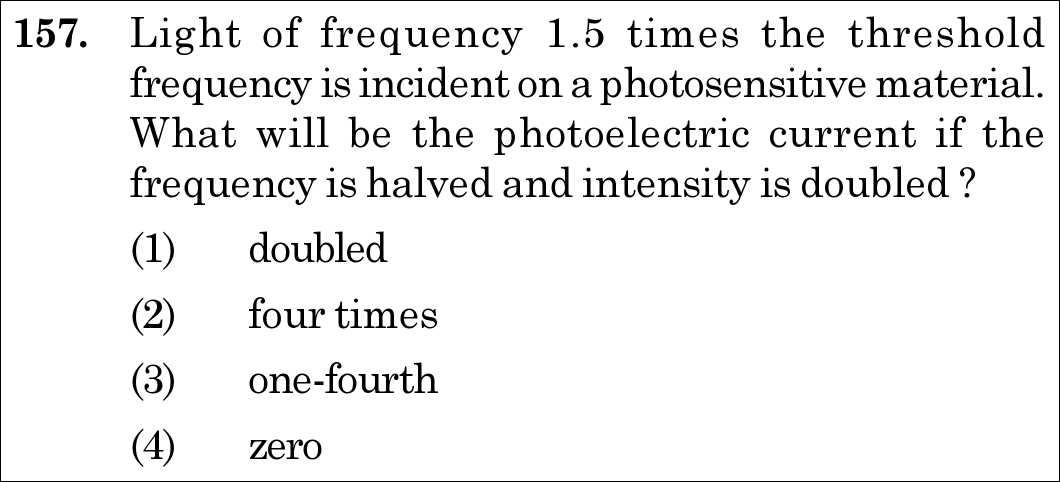
NEET 2020 Physics Question 157: Threshold Frequency Cutoff: Photoelectric Current is Zero When ν < ν0

Question

Light of frequency 1.5 times the threshold frequency is incident on a photosensitive material. What will be the photoelectric current if the frequency is halved and intensity is doubled?

  1. (1)doubled
  2. (2)four times
  3. (3)one-fourth
  4. (4)zero
✓
Verified Against NTA Final Answer Key
Option (4) : zero
📚 Dual Nature of Radiation and Matter Easy
📋 Given Parameters & Problem Setup
Initial Frequency (ν) 1.5 ν0 (where ν0 is threshold frequency)
Frequency Modification Frequency is halved: ν' = ν / 2
Intensity Modification Intensity is doubled: I' = 2 I
Question Objective Find the resulting photoelectric current
⚡

The 30-Second Exam Hall Shortcut: ⚡ "Frequency Halved: ν' = 1.5 ν0 / 2 = 0.75 ν0 < ν0 -> BELOW THRESHOLD -> NO EMISSION -> CURRENT IS ZERO!"

⏱️ 20 seconds

The initial frequency is ν=1.5ν0\nu = 1.5\nu_0. When the frequency is halved, the new incident frequency becomes ν′=1.5ν02=0.75ν0\nu' = \frac{1.5\nu_0}{2} = 0.75\nu_0. Because ν′<ν0\nu' < \nu_0 (below the threshold frequency), the incident photon energy (hν′h\nu') is less than the work function (ϕ0=hν0\phi_0 = h\nu_0). No photoelectric emission occurs, NO MATTER HOW HIGH THE INTENSITY IS! Photoelectric current is ZERO! Mark zero (Option 4) in 5 seconds.

1 Given initial frequency: ν = 1.5 ν0.
2 New frequency after halving: ν' = 1.5 ν0 / 2 = 0.75 ν0.
3 Compare with threshold: 0.75 ν0 < ν0 (frequency is below threshold frequency).
4 Einstein's photoelectric law: If incident frequency is less than threshold frequency, NO photoelectrons are emitted.
5 Doubling the intensity cannot produce photoelectrons if frequency is below threshold.
6 Photoelectric current = 0.
7 Select Option (4) zero.
🛡️
Why You Can 100% Trust This Shortcut: NCERT Physics · Dual Nature of Radiation and Matter (Photoelectric Effect: Effect of Frequency and Threshold Frequency)
📐

Step-by-Step Rigorous Workflow & Mathematical Proof

Step 1

Understand the Threshold Frequency Concept

According to Einstein's photoelectric equation, the maximum kinetic energy of emitted photoelectrons is: Kmax=hν−ϕ0=h(ν−ν0)K_{\text{max}} = h\nu - \phi_0 = h(\nu - \nu_0) For any photoelectrons to be emitted, the energy of the incident photon must be at least equal to the work function (hν≥hν0  ⟹  ν≥ν0h\nu \ge h\nu_0 \implies \nu \ge \nu_0).

Step 2

Calculate the New Incident Frequency

The initial frequency of incident light is: ν=1.5ν0\nu = 1.5 \nu_0 When the frequency is halved: ν′=ν2=1.5ν02=0.75ν0\nu' = \frac{\nu}{2} = \frac{1.5\nu_0}{2} = 0.75\nu_0

Step 3

Examine Photoelectric Emission Condition

Notice that the new frequency ν′=0.75ν0\nu' = 0.75\nu_0 is strictly LESS than the threshold frequency ν0\nu_0: ν′<ν0\nu' < \nu_0 When the frequency is below the threshold frequency, the photon energy is insufficient to liberate even a single electron from the surface.

Step 4

Examine Effect of Doubling Intensity

Intensity corresponds to the number of incident photons per second. Since each individual photon carries energy less than the work function (hν′<ϕ0h\nu' < \phi_0), increasing the number of photons cannot cause emission. Hence, no photoelectrons are ejected, and the photoelectric current drops to exactly ZERO.

⭐

360° Option Elimination Engine Key Feature

Diagnose every choice: Know exactly why the right option works and why distractors fail.

4-Option Deep Scan
1 A
✗ Incorrect
Verdict & Scientific Reason:

Incorrect; classic trap of assuming photoelectric current is proportional to intensity without checking the threshold frequency condition.

⚠️
Student Fallacy (Why candidates pick this trap): Focusing solely on "intensity is doubled" and overlooking that frequency is below threshold.
2 B
✗ Incorrect
Verdict & Scientific Reason:

Incorrect; arbitrary multiplication.

⚠️
Student Fallacy (Why candidates pick this trap): Guessing.
3 C
✗ Incorrect
Verdict & Scientific Reason:

Incorrect; trying to combine 1/2 frequency with intensity.

⚠️
Student Fallacy (Why candidates pick this trap): Attempting invalid algebraic ratio scaling.
4 D
✓ 100% Correct
Verdict & Scientific Reason:

Factually and physically exact; because the new frequency (0.75 ν0) is below the threshold frequency, no photoelectrons are emitted.

💡
Why this is airtight: None; rigorous conceptual mastery of threshold frequency.
⚠️

NTA Trap Alert: The "Intensity Doubled" Trap

Students immediately see "intensity is doubled" and select "doubled" (Option 1). ALWAYS CHECK FREQUENCY FIRST! If ν<ν0\nu < \nu_0, emission is physically IMPOSSIBLE and current is ZERO regardless of intensity!

🛡️ How to avoid the -1 mark: Check frequency threshold first: 1.5 / 2 = 0.75 < 1 -> Current is ZERO!
📖

Core NEET Syllabus Standard

Physics · Dual Nature of Radiation and Matter Standard Benchmark
Core Scientific Principle Tested:

""

Syllabus Focus: Threshold Frequency Cutoff: Photoelectric Current is Zero When ν < ν0
✓ Core NEET UG Syllabus Anchor Syllabus & Academic Standards ↗

Ready to attempt under real exam pressure?

Test your speed and accuracy in the authentic 180-minute timed NTA simulator.

Launch NEET 2020 CBT Test →

Spotted a mistake in this solution? Report an error ([email protected])

⚖️ Legal & Fair Dealing Notice: Sourced from publicly released NEET 2020 question papers and NEET answer keys for private study, research, and non-commercial educational practice under Fair Dealing (Section 52(1)(a) of the Indian Copyright Act, 1957). Not affiliated with or endorsed by NTA or NMC.

Solve 4 NEET Questions a Day — One per Subject

Cover all 1,140 official NEET questions in 285 days at your own pace. Progress is saved on your device. No login needed.