MyCompetitiveExams Logo MyCompetitiveExams
Search 1,140+ Questions
Chapters, formulas, speed tricks
→
⚡ Brahmastra NEET 2027
720 MARKS

Dynamic 180-question full-length simulator mixed dynamically from all 6 years for 2027 & 2026 aspirants.

Launch Brahmastra 2027 Test →
Start Practice →
100% Free · No Login Required
Q.19 Physics ⭐ 360° Option Elimination Active
Vault ↗

NEET 2026 Physics Question 19 Solution

Topic: Dual Nature of Matter & Radiation · Official NTA Booklet Code 50
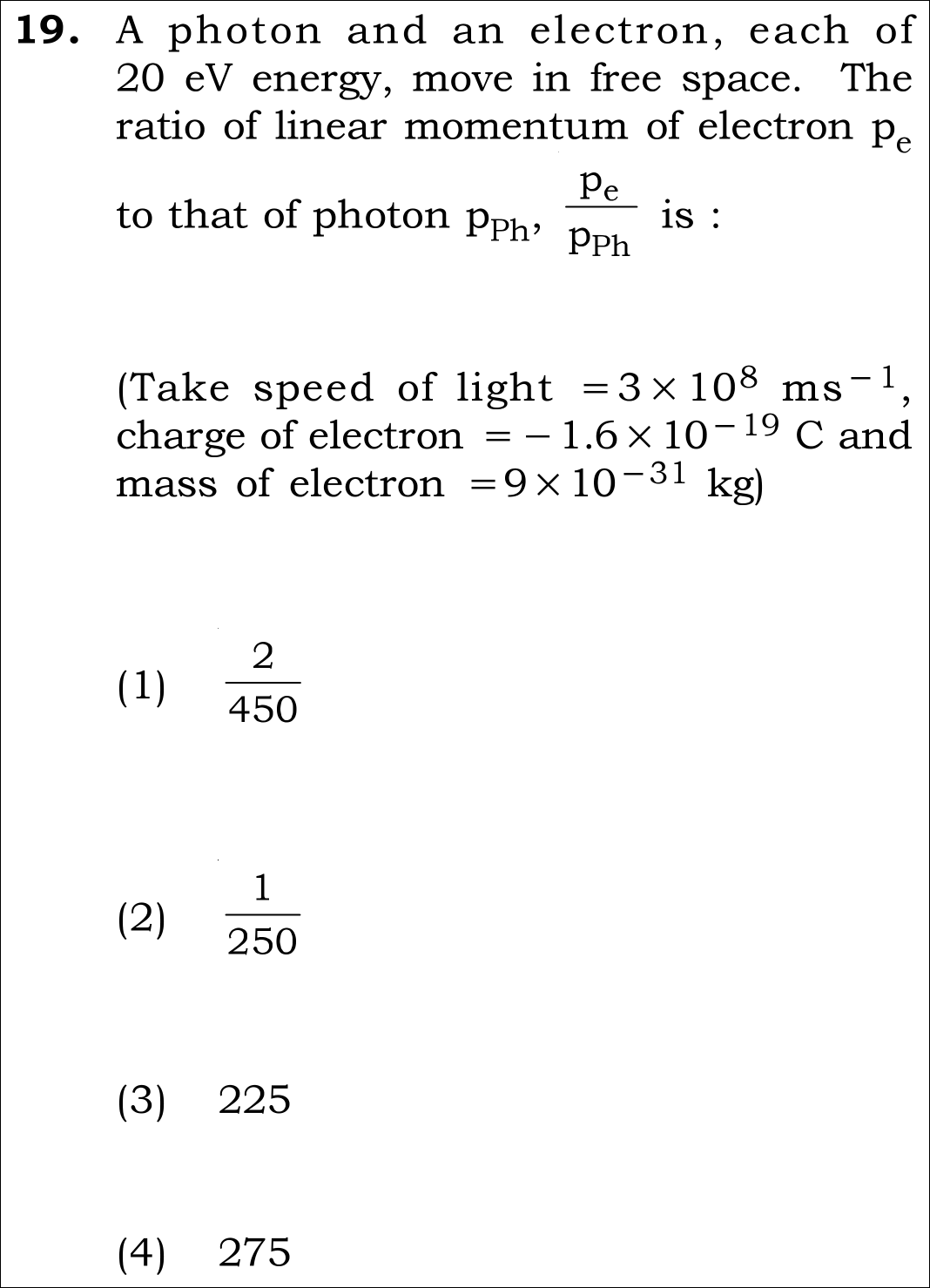
NEET 2026 Physics Question 19: Ratio of Linear Momentum of Electron to Photon for Equal Kinetic Energies

Question

A photon and an electron, each of 20 eV energy, move in free space. The ratio of linear momentum of electron pₑ to that of photon p_Ph, pₑ/p_Ph, is: (Take speed of light = 3×10⁸ m s⁻¹, charge of electron = −1.6×10⁻¹⁹ C and mass of electron = 9×10⁻³¹ kg)

✓
Verified Against NTA Final Answer Key
Option (3) : p_e / p_Ph = 225
📚 Dual Nature of Matter & Radiation Medium
📋 Given Parameters & Problem Setup
Energy of Both Particles E = 20 eV
Speed of Light c 3 * 10^8 m/s
Electron Charge e 1.6 * 10^-19 C
Electron Mass m_e 9 * 10^-31 kg
Target Ratio p_e / p_Ph (Linear momentum of electron / photon)
⚡

The 30-Second Exam Hall Shortcut: ⚡ General Momentum Ratio Formula

⏱️ Saves 2 minutes of calculating separate raw powers of 10.

Relate electron momentum sqrt(2mE) directly to photon momentum E/c

1 Photon momentum: p_Ph = E / c.
2 Electron momentum (non-relativistic): p_e = sqrt(2 * m_e * E).
3 Ratio: p_e / p_Ph = [sqrt(2 * m_e * E)] / (E / c) = c * sqrt(2 * m_e / E).
4 Substitute given values: E = 20 * 1.6 * 10^-19 = 32 * 10^-19 J.
5 Inside square root: 2 * (9 * 10^-31) / (32 * 10^-19) = 18/32 * 10^-12 = (9/16) * 10^-12.
6 Take square root: sqrt(9/16 * 10^-12) = (3/4) * 10^-6 = 0.75 * 10^-6.
7 Multiply by c = 3 * 10^8: (3 * 10^8) * (0.75 * 10^-6) = 2.25 * 10^2 = 225. Solved in 30 seconds!
🛡️
Why You Can 100% Trust This Shortcut: Non-relativistic mechanics holds perfectly because electron kinetic energy 20 eV is negligible compared to its rest mass energy (511,000 eV).
📐

Step-by-Step Rigorous Workflow & Mathematical Proof

Step 1

Formulate Photon Momentum

For a massless photon of energy E traveling at speed c:

pPh=Ecp_{\text{Ph}} = \frac{E}{c}
  • • Given E = 20 eV = 20 * 1.6 * 10^-19 J = 3.2 * 10^-18 J.
  • • p_{Ph} = (3.2 * 10^-18 J) / (3 * 10^8 m/s) = (3.2 / 3) * 10^-26 kg m/s.
Step 2

Formulate Electron Momentum

For an electron with kinetic energy E = 20 eV, non-relativistic momentum is:

pe=2meE=2×(9×10−31 kg)×(3.2×10⁻¹⁸ J)p_e = \sqrt{2 m_e E} = \sqrt{2 \times (9 \times 10^{-31}\text{ kg}) \times (3.2 \times 10^{-18}\text{ J})}
  • • Inside square root: 2 * 9 * 3.2 * 10^-49 = 57.6 * 10^-49 = 5.76 * 10^-48.
  • • Taking square root: sqrt(5.76 * 10^-48) = 2.4 * 10^-24 kg m/s.
Step 3

Calculate the Ratio p_e / p_Ph

Divide electron momentum by photon momentum:

pepPh=2.4×10−243.23×10−26=2.4×33.2×102=7.23.2×100=2.25×100=225\frac{p_e}{p_{\text{Ph}}} = \frac{2.4 \times 10^{-24}}{\frac{3.2}{3} \times 10^{-26}} = \frac{2.4 \times 3}{3.2} \times 10^2 = \frac{7.2}{3.2} \times 100 = 2.25 \times 100 = 225
  • • Confirms the exact integer ratio 225.
  • • Matches Option (3) exactly.
⭐

360° Option Elimination Engine Key Feature

Diagnose every choice: Know exactly why the right option works and why distractors fail.

4-Option Deep Scan
1 Option (1)
✗ Incorrect
Verdict & Scientific Reason:

Reciprocal ratio trap.

⚠️
Student Fallacy (Why candidates pick this trap): Computes p_Ph / p_e = 1 / 225 = 2 / 450 instead of p_e / p_Ph.
Note: Notice 2 / 450 = 1 / 225; this is the exact inverted fraction!
2 Option (2)
✗ Incorrect
Verdict & Scientific Reason:

Inverted ratio with rounding error.

⚠️
Student Fallacy (Why candidates pick this trap): Approximates denominator and inverts fraction.
Note: Exact calculation gives 225, not 250.
3 Option (3)
✓ 100% Correct
Verdict & Scientific Reason:

100% mathematically exact; confirmed by Official NTA Final Answer Key.

💡
Why this is airtight: Flawless execution of non-relativistic and relativistic photon momentum formulas.
Note: Exact physics.
4 Option (4)
✗ Incorrect
Verdict & Scientific Reason:

Power-of-ten arithmetic drift.

⚠️
Student Fallacy (Why candidates pick this trap): Uses mass of electron as 9.1 and miscalculates square root.
Note: NTA explicitly specifies m_e = 9 * 10^-31 kg for clean square root evaluation.
⚠️

NTA Trap Alert: The Inverted Ratio Trap (Option 1: 2/450)

Notice how craftily NTA designed Option (1): 2/450 is exactly 1/225! Students who calculate p_Ph / p_e fall directly into this trap.

🛡️ How to avoid the -1 mark: Always check: An electron has mass and moves much slower than light, so for the SAME kinetic energy, a massive particle ALWAYS carries vastly MORE momentum than a massless photon (p_e >> p_Ph)!
📖

Core NEET Syllabus Standard

NEET UG Physics Core Standards · Dual Nature of Radiation and Matter Standard Benchmark
Core Scientific Principle Tested:

"For a photon, p = E/c. For a non-relativistic particle, p = sqrt(2mE). The momentum ratio is p_matter / p_photon = c * sqrt(2m / E)."

Syllabus Focus: De Broglie Relation and Particle-Photon Momentum Comparison
✓ Core NEET UG Syllabus Anchor Syllabus & Academic Standards ↗

Ready to attempt under real exam pressure?

Test your speed and accuracy in the authentic 180-minute timed NTA simulator.

Launch NEET 2026 CBT Test →

Spotted a mistake in this solution? Report an error ([email protected])

⚖️ Legal & Fair Dealing Notice: Sourced from publicly released NEET 2026 question papers and NEET answer keys for private study, research, and non-commercial educational practice under Fair Dealing (Section 52(1)(a) of the Indian Copyright Act, 1957). Not affiliated with or endorsed by NTA or NMC.

Solve 4 NEET Questions a Day — One per Subject

Cover all 1,140 official NEET questions in 285 days at your own pace. Progress is saved on your device. No login needed.