MyCompetitiveExams Logo MyCompetitiveExams
Search 1,140+ Questions
Chapters, formulas, speed tricks
→
⚡ Brahmastra NEET 2027
720 MARKS

Dynamic 180-question full-length simulator mixed dynamically from all 6 years for 2027 & 2026 aspirants.

Launch Brahmastra 2027 Test →
Start Practice →
100% Free · No Login Required
Q.44 Botany ⭐ 360° Option Elimination Active
Vault ↗

NEET 2020 Botany Question 44 Solution

Topic: Evolution · Official NTA Booklet Code E1
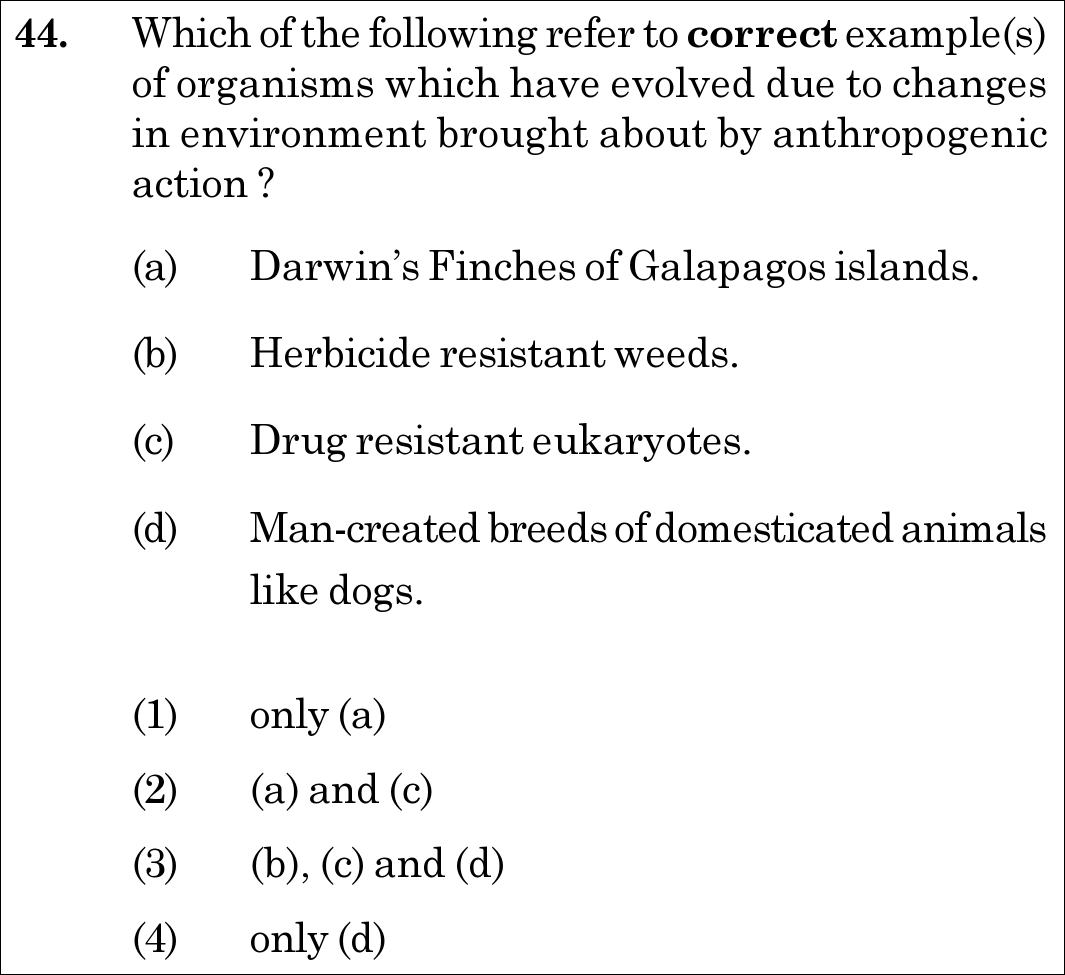
NEET 2020 Botany Question 44: Evolution by Anthropogenic Action vs Natural Adaptive Radiation

Question

Which of the following refer to correct example(s) of organisms which have evolved due to changes in environment brought about by anthropogenic action? (a) Darwin's Finches of Galapagos islands. (b) Herbicide resistant weeds. (c) Drug resistant eukaryotes. (d) Man-created breeds of domesticated animals like dogs.

  1. (1)only (a)
  2. (2)(a) and (c)
  3. (3)(b), (c) and (d)
  4. (4)only (d)
✓
Verified Against NTA Final Answer Key
Option (3) : (b), (c) and (d)
📚 Evolution Easy
📋 Given Parameters & Problem Setup
Example (a) Darwin's Finches of Galapagos islands
Example (b) Herbicide resistant weeds
Example (c) Drug resistant eukaryotes
Example (d) Man-created breeds of domesticated animals like dogs
Question Objective Identify which examples represent evolution by anthropogenic (human) action
⚡

The 30-Second Exam Hall Shortcut: ⚡ "Anthropogenic = Human-Driven! Finches Are Natural Adaptive Radiation!"

⏱️ 30 seconds

Darwin's finches (a) evolved by natural adaptive radiation in the wild without human intervention. Herbicide resistance (b), drug resistance (c), and artificial animal breeding (d) are direct results of human activities (anthropogenic action). Correct answer is (b), (c) and (d) (Option 3)!

1 Anthropogenic means caused or produced by human activity.
2 Darwin's finches (a) = Natural adaptive radiation (exclude a).
3 Herbicide resistance (b), drug resistance (c), and artificial breeding (d) = Anthropogenic evolution.
4 Match combination: (b), (c) and (d) -> Option 3.
🛡️
Why You Can 100% Trust This Shortcut: NCERT Biology · Evolution (Evolution by Anthropogenic Action: Pesticides, Drugs & Artificial Selection)
📐

Step-by-Step Rigorous Workflow & Mathematical Proof

Step 1

Define Anthropogenic Action in Evolution

Evolution by anthropogenic action refers to evolutionary changes and adaptations in organisms driven, accelerated, or mediated by human activities, such as artificial selection, environmental pollution, pesticide overuse, and antibiotic drug pressure.

Step 2

Evaluate Darwin's Finches (a)

Darwin's finches on the Galapagos islands diversified from a common ancestral seed-eating stock through natural adaptive radiation into diverse ecological niches, completely independent of human influence.

Step 3

Evaluate Chemical and Drug Resistances (b and c)

Excessive and uncontrolled human application of chemical herbicides and antiparasitic/antibiotic drugs has led to directional selection favoring resistant strains of weeds and resistant eukaryotes/microbes (e.g., chloroquine-resistant Plasmodium, antibiotic-resistant bacteria) within months or years. These are classic anthropogenic evolutionary cases highlighted in NCERT.

Step 4

Evaluate Artificial Dog Breeds (d)

Humans have artificially bred and selected various domesticated animal breeds (dogs, cattle, horses) over hundreds of years, representing classic artificial selection by anthropogenic action.

Step 5

Combine Correct Letters

Statements (b), (c), and (d) are all unambiguous examples of evolution brought about by anthropogenic action.

⭐

360° Option Elimination Engine Key Feature

Diagnose every choice: Know exactly why the right option works and why distractors fail.

4-Option Deep Scan
1 A
✗ Incorrect
Verdict & Scientific Reason:

Incorrect; Darwin's finches evolved by natural adaptive radiation, not anthropogenic action.

⚠️
Student Fallacy (Why candidates pick this trap): Misunderstanding the term "anthropogenic" as general evolution.
2 B
✗ Incorrect
Verdict & Scientific Reason:

Incorrect; erroneously includes (a) and omits (b) and (d).

⚠️
Student Fallacy (Why candidates pick this trap): Failing to distinguish natural ecological diversification from human-induced selection.
3 C
✓ 100% Correct
Verdict & Scientific Reason:

Factually exact; herbicide-resistant weeds, drug-resistant eukaryotes, and man-created dog breeds are all products of anthropogenic selection.

💡
Why this is airtight: None; matches the explicit examples provided in NCERT evolution chapter.
4 D
✗ Incorrect
Verdict & Scientific Reason:

Incorrect; incomplete because herbicide resistance and drug resistance are also prominent anthropogenic evolutionary adaptations.

⚠️
Student Fallacy (Why candidates pick this trap): Assuming anthropogenic action only applies to deliberate artificial breeding of pets.
⚠️

NTA Trap Alert: Adaptive Radiation vs Anthropogenic Selection

Darwin's finches and Australian marsupials are ADAPTIVE RADIATION. Industrial melanism in moths, pesticide/herbicide resistance, antibiotic resistance, and artificial breeding are ANTHROPOGENIC ACTION.

🛡️ How to avoid the -1 mark: Ask yourself: Did human activity cause the selection pressure? If yes = Anthropogenic. If wild nature = Natural adaptive radiation!
📖

Core NEET Syllabus Standard

Botany · Evolution Standard Benchmark
Core Scientific Principle Tested:

""

Syllabus Focus: Evolution by Anthropogenic Action vs Natural Adaptive Radiation
✓ Core NEET UG Syllabus Anchor Syllabus & Academic Standards ↗

Ready to attempt under real exam pressure?

Test your speed and accuracy in the authentic 180-minute timed NTA simulator.

Launch NEET 2020 CBT Test →

Spotted a mistake in this solution? Report an error ([email protected])

⚖️ Legal & Fair Dealing Notice: Sourced from publicly released NEET 2020 question papers and NEET answer keys for private study, research, and non-commercial educational practice under Fair Dealing (Section 52(1)(a) of the Indian Copyright Act, 1957). Not affiliated with or endorsed by NTA or NMC.

Solve 4 NEET Questions a Day — One per Subject

Cover all 1,140 official NEET questions in 285 days at your own pace. Progress is saved on your device. No login needed.