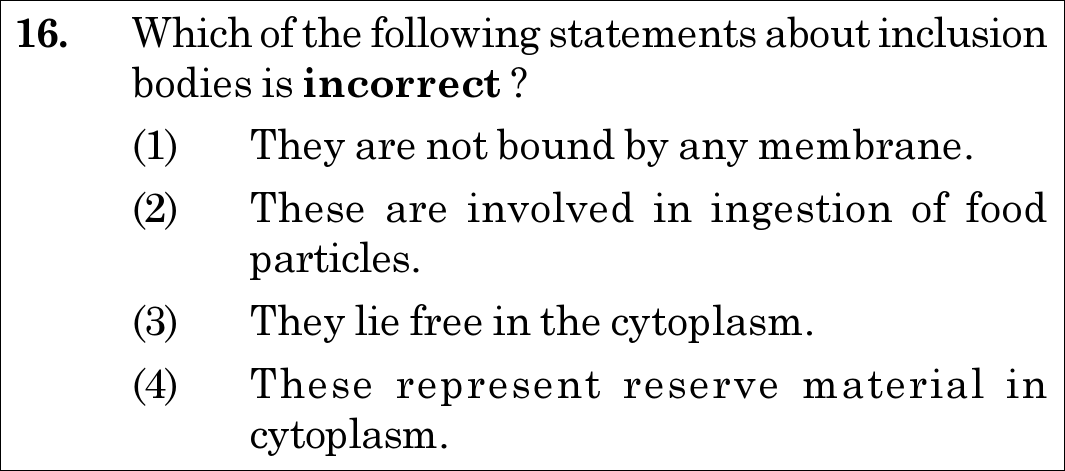
Inclusion bodies in prokaryotes store reserve nutrients non-membranously (phosphate granules, cyanophycean granules, glycogen granules) floating freely in the cytoplasm. Bacteria lack endocytosis; inclusion bodies NEVER ingest food! Statement (2) is false. Select Option (2).
1 Recall NCERT characteristics of inclusion bodies:
- Reserve material in prokaryotic cells is stored in cytoplasm in the form of inclusion bodies.
- They are NOT bound by any membrane system.
- They lie free in the cytoplasm (e.g. phosphate granules, cyanophycean granules, glycogen granules).
- Gas vacuoles are found in photosynthetic bacteria.
2 Check statement (2): "These are involved in ingestion of food particles" -> Completely false (bacteria have rigid peptidoglycan walls and cannot ingest particles via phagocytosis).
3 Statement (2) is incorrect and is the required answer.
🛡️ Why You Can 100% Trust This Shortcut: NCERT Biology · Cell: The Unit of Life (Prokaryotic Cells: Reserve material in prokaryotic cells are stored in the cytoplasm in the form of inclusion bodies. These are not bound by any membrane system and lie free in the cytoplasm, e.g., phosphate granules, cyanophycean granules and glycogen granules).