MyCompetitiveExams Logo MyCompetitiveExams
Search 1,140+ Questions
Chapters, formulas, speed tricks
→
⚡ Brahmastra NEET 2027
720 MARKS

Dynamic 180-question full-length simulator mixed dynamically from all 6 years for 2027 & 2026 aspirants.

Launch Brahmastra 2027 Test →
Start Practice →
100% Free · No Login Required
Q.85 Chemistry ⭐ 360° Option Elimination Active
Vault ↗

NEET 2023 Chemistry Question 85 Solution

Topic: The s-Block Elements · Official NTA Booklet Code G5
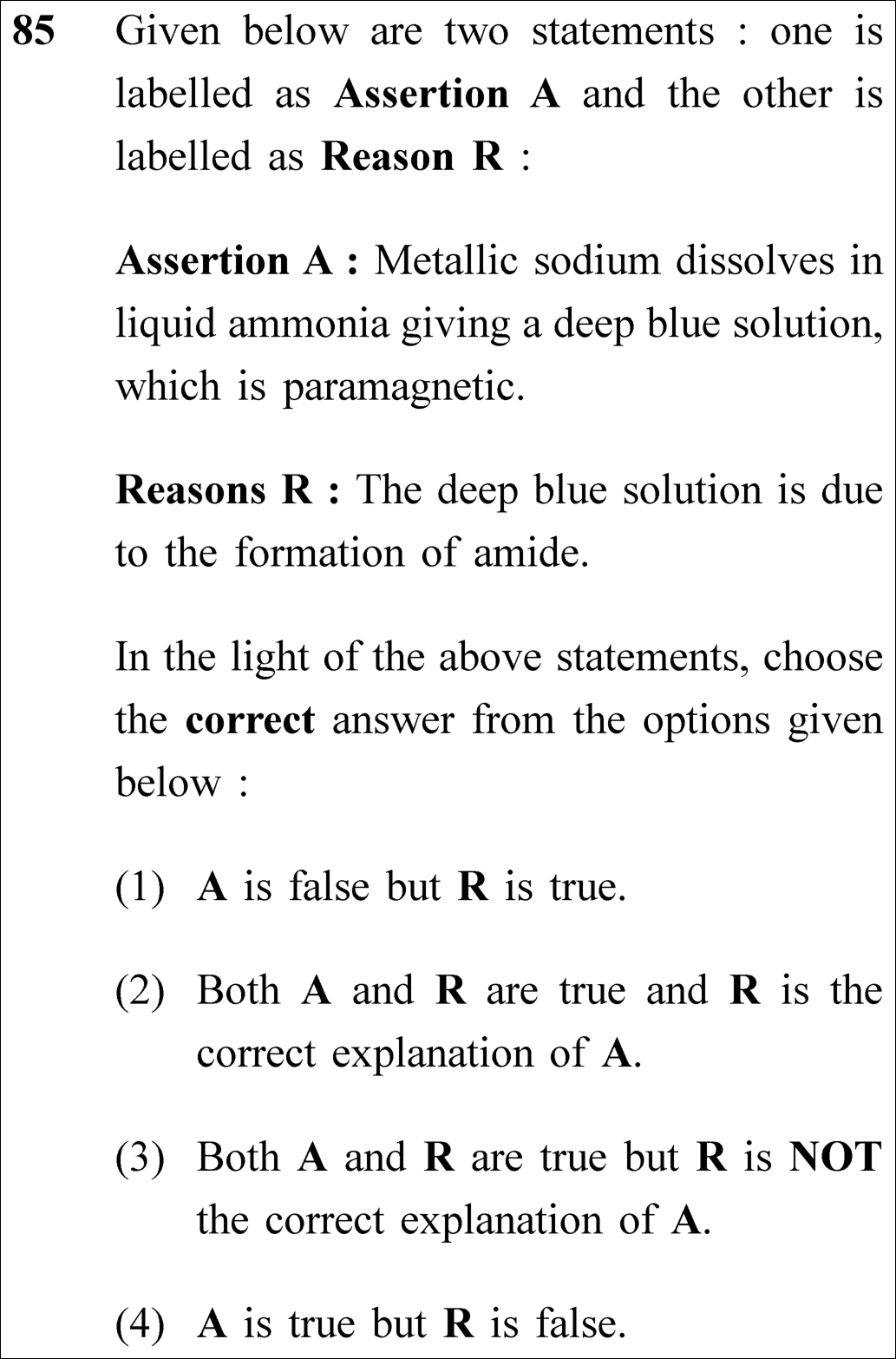
NEET 2023 Chemistry Question 85: Solutions of Alkali Metals in Liquid Ammonia (Assertion-Reason)

Question

Given below are two statements: one is labelled as Assertion A and the other is labelled as Reason R: Assertion A: Metallic sodium dissolves in liquid ammonia giving a deep blue solution, which is paramagnetic. Reasons R: The deep blue solution is due to the formation of amide. In the light of the above statements, choose the correct answer from the options given below:

  1. (1)A is false but R is true.
  2. (2)Both A and R are true and R is the correct explanation of A.
  3. (3)Both A and R are true but R is NOT the correct explanation of A.
  4. (4)A is true but R is false.
✓
Verified Against NTA Final Answer Key
Option (4) : A is true but R is false.
📚 The s-Block Elements Medium
📋 Given Parameters & Problem Setup
Assertion A Metallic sodium dissolves in liquid ammonia giving a deep blue solution, which is paramagnetic.
Reason R The deep blue solution is due to the formation of amide.
⚡

The 30-Second Exam Hall Shortcut: ⚡ Solvated Electron Hallmark: Blue Color is Due to Ammoniated Electrons, NOT Amide!

⏱️ Save ~25 seconds

Sodium dissolves in liquid ammonia to form ammoniated cations and ammoniated electrons: Na + (x+y)NH₃ → [Na(NH₃)x]⁺ + [e(NH₃)y]⁻. The ammoniated electron absorbs in the visible red region, giving the deep blue color, and is paramagnetic (Assertion is TRUE). Reason claims the blue color is due to amide formation, which is FALSE (amide formation discharges the blue color and liberates H₂ gas). Lock Option (4)!

1 Evaluate Assertion A: Dilute alkali metal solutions in liquid NH₃ are deep blue and paramagnetic due to unpaired ammoniated electrons (TRUE).
2 Evaluate Reason R: Reason claims blue color is due to sodamide (NaNH₂). In fact, sodamide formation is the decomposition reaction that consumes the solvated electrons and bleaches the blue color! (FALSE).
3 Match: A is true but R is false (Option 4).
🛡️
Why You Can 100% Trust This Shortcut: NCERT Group 1 Elements property of solutions in liquid ammonia.
📐

Step-by-Step Rigorous Workflow & Mathematical Proof

Step 1

Analyze Assertion A: Dissolution of Sodium in Liquid Ammonia

Alkali metals dissolve in liquid ammonia to form dilute solutions that are conducting and deep blue in color:

Na+(x+y)NH3→[Na(NH3)x]++[e(NH3)y]−\text{Na} + (x+y)\text{NH}_3 \rightarrow [\text{Na}(\text{NH}_3)_x]^+ + [e(\text{NH}_3)_y]^-
Step 2

Photophysical Origin of Color and Paramagnetism

The ammoniated electrons absorb energy in the red region of visible light, imparting a deep blue color. Because these solvated electrons possess unpaired spins, the solution is paramagnetic. Assertion A is TRUE:

Unpaired ammoniated electrons [e(NH3)y]−  ⟹  Deep blue color + Paramagnetism\text{Unpaired ammoniated electrons } [e(\text{NH}_3)_y]^- \implies \text{Deep blue color } + \text{ Paramagnetism}
Step 3

Analyze Reason R: Amide Formation Decomposition

Reason R asserts that the blue color is due to the formation of sodamide (NaNH₂). In reality, amide formation destroys the ammoniated electrons and liberates H₂ gas, bleaching the blue color:

Na++e−+NH3→standing/catalystNaNH2+12H2(g)(Bronze/colorless, diamagnetic)\text{Na}^+ + e^- + \text{NH}_3 \xrightarrow{\text{standing/catalyst}} \text{NaNH}_2 + \frac{1}{2}\text{H}_2(g) \quad (\text{Bronze/colorless, diamagnetic})
⭐

360° Option Elimination Engine Key Feature

Diagnose every choice: Know exactly why the right option works and why distractors fail.

4-Option Deep Scan
1 (1)
✗ Incorrect
Verdict & Scientific Reason:

Inverted logic: Assertion is true, and Reason is false.

⚠️
Student Fallacy (Why candidates pick this trap): Candidate incorrectly thought sodium metal does not form paramagnetic solutions in liquid ammonia.
2 (2)
✗ Incorrect
Verdict & Scientific Reason:

Reason is false; sodamide is not the chromophore responsible for the blue color.

⚠️
Student Fallacy (Why candidates pick this trap): Candidate incorrectly believed that amide is the blue-colored species.
3 (3)
✗ Incorrect
Verdict & Scientific Reason:

Reason is false, so both statements cannot be true.

⚠️
Student Fallacy (Why candidates pick this trap): Candidate failed to realize that amide formation destroys the blue color.
4 (4)
✓ 100% Correct
Verdict & Scientific Reason:

Accurate: Deep blue color arises from ammoniated electrons (A is true), not from amide formation (R is false).

💡
Why this is airtight: None. Candidate recognized that ammoniated electrons cause the blue color.
⚠️

NTA Trap Alert: Equating Ammoniated Electrons with Amides

Candidates frequently remember the word "amide" from the chapter and mistakenly assume it causes the blue color. Amide formation (NaNH₂) is the decomposition reaction that consumes the ammoniated electron and releases H₂ gas, bleaching the blue color!

🛡️ How to avoid the -1 mark: Remember: Blue color = Ammoniated electron [e(NH₃)y]⁻. Bronze/colorless = Amide (NaNH₂) + H₂.
📖

Core NEET Syllabus Standard

National Eligibility cum Entrance Test (NEET UG) · The s-Block Elements Standard Benchmark
Core Scientific Principle Tested:

"The blue color of alkali metal solutions in liquid ammonia is caused by excitation of ammoniated electrons, which are paramagnetic."

Syllabus Focus: Group 1 Elements – Solutions in Liquid Ammonia
Preserved in Rationalized Curriculum Syllabus & Academic Standards ↗

Ready to attempt under real exam pressure?

Test your speed and accuracy in the authentic 200-minute timed NTA simulator.

Launch NEET 2023 CBT Test →

Spotted a mistake in this solution? Report an error ([email protected])

⚖️ Legal & Fair Dealing Notice: Sourced from publicly released NEET 2023 question papers and NEET answer keys for private study, research, and non-commercial educational practice under Fair Dealing (Section 52(1)(a) of the Indian Copyright Act, 1957). Not affiliated with or endorsed by NTA or NMC.

Solve 4 NEET Questions a Day — One per Subject

Cover all 1,140 official NEET questions in 285 days at your own pace. Progress is saved on your device. No login needed.