MyCompetitiveExams Logo MyCompetitiveExams
Search 1,140+ Questions
Chapters, formulas, speed tricks
→
⚡ Brahmastra NEET 2027
720 MARKS

Dynamic 180-question full-length simulator mixed dynamically from all 6 years for 2027 & 2026 aspirants.

Launch Brahmastra 2027 Test →
Start Practice →
100% Free · No Login Required
Q.80 Zoology ⭐ 360° Option Elimination Active
Vault ↗

NEET 2020 Zoology Question 80 Solution

Topic: Chemical Coordination and Integration · Official NTA Booklet Code E1
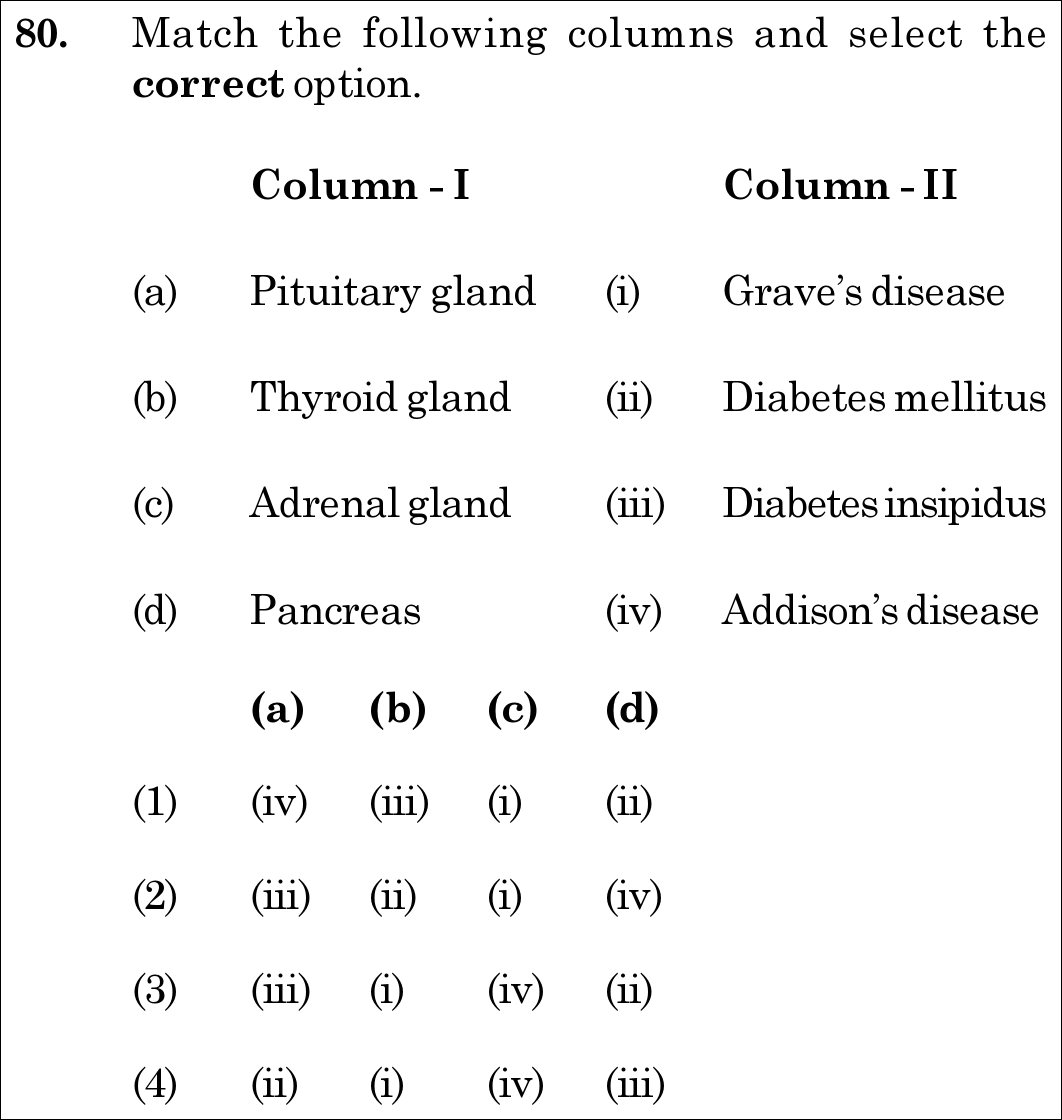
NEET 2020 Zoology Question 80: Endocrine Glands and Associated Disorders Match

Question

Match the following columns and select the correct option. Column - I Column - II (a) Pituitary gland (i) Grave's disease (b) Thyroid gland (ii) Diabetes mellitus (c) Adrenal gland (iii) Diabetes insipidus (d) Pancreas (iv) Addison's disease (a) (b) (c) (d)

  1. (1)(iv) (iii) (i) (ii)
  2. (2)(iii) (ii) (i) (iv)
  3. (3)(iii) (i) (iv) (ii)
  4. (4)(ii) (i) (iv) (iii)
✓
Verified Against NTA Final Answer Key
Option (3) : (a)-(iii), (b)-(i), (c)-(iv), (d)-(ii)
📚 Chemical Coordination and Integration Easy
📋 Given Parameters & Problem Setup
Column I (Endocrine Glands) (a) Pituitary gland, (b) Thyroid gland, (c) Adrenal gland, (d) Pancreas
Column II (Disorders) (i) Grave's disease, (ii) Diabetes mellitus, (iii) Diabetes insipidus, (iv) Addison's disease
⚡

The 30-Second Exam Hall Shortcut: ⚡ "Pituitary = Diabetes Insipidus; Thyroid = Grave's; Adrenal = Addison's; Pancreas = Diabetes Mellitus!"

⏱️ 25 seconds

Pituitary undersecretion of ADH causes Diabetes insipidus (a->iii). Thyroid hypersecretion causes Grave's disease (b->i). Adrenal cortex hyposecretion causes Addison's disease (c->iv). Pancreas insulin deficiency causes Diabetes mellitus (d->ii). Match: (iii), (i), (iv), (ii) -> Option 3 in 10 seconds!

1 Pituitary gland (neurohypophysis releases ADH): Deficiency leads to Diabetes insipidus -> (a)-(iii).
2 Thyroid gland: Hyperthyroidism causes Grave's disease (exophthalmic goitre) -> (b)-(i).
3 Adrenal gland (adrenal cortex hyposecretion): Addison's disease -> (c)-(iv).
4 Pancreas (beta-cells insulin deficiency): Diabetes mellitus -> (d)-(ii).
5 Mapping: (a)-(iii), (b)-(i), (c)-(iv), (d)-(ii) -> Option 3.
🛡️
Why You Can 100% Trust This Shortcut: NCERT Biology · Human Physiology: Chemical Coordination and Integration (Endocrine Disorders)
📐

Step-by-Step Rigorous Workflow & Mathematical Proof

Step 1

Match Pituitary Gland

The posterior pituitary (neurohypophysis) releases vasopressin/ADH. Hyposecretion or impairment of ADH synthesis leads to inability of kidney to conserve water, resulting in copious dilute urine excretion known as Diabetes insipidus. Thus, (a) matches (iii).

Step 2

Match Thyroid Gland

Grave's disease is a form of hyperthyroidism characterized by enlargement of the thyroid gland, protrusion of the eyeballs (exophthalmos), increased basal metabolic rate, and weight loss. Thus, (b) matches (i).

Step 3

Match Adrenal Gland

Underproduction of hormones by the adrenal cortex (mineralocorticoids and glucocorticoids) alters carbohydrate metabolism, causing acute weakness and fatigue, leading to Addison's disease. Thus, (c) matches (iv).

Step 4

Match Pancreas

Hyposecretion of insulin by the beta-cells of the islets of Langerhans in the pancreas impairs glucose uptake, leading to prolonged hyperglycemia, glycosuria, and ketone body formation (Diabetes mellitus). Thus, (d) matches (ii).

⭐

360° Option Elimination Engine Key Feature

Diagnose every choice: Know exactly why the right option works and why distractors fail.

4-Option Deep Scan
1 A
✗ Incorrect
Verdict & Scientific Reason:

Incorrect; attributes Addison's disease to the pituitary gland.

⚠️
Student Fallacy (Why candidates pick this trap): Confusing adrenal and pituitary disorders.
2 B
✗ Incorrect
Verdict & Scientific Reason:

Incorrect; attributes Diabetes mellitus to the thyroid gland.

⚠️
Student Fallacy (Why candidates pick this trap): Swapping thyroid and pancreatic pathologies.
3 C
✓ 100% Correct
Verdict & Scientific Reason:

Accurate pairing across all four endocrine glands and their respective clinical disorders.

💡
Why this is airtight: None; canonical endocrine disorder matching.
4 D
✗ Incorrect
Verdict & Scientific Reason:

Incorrect; confuses Diabetes mellitus (pancreas) with Diabetes insipidus (pituitary ADH).

⚠️
Student Fallacy (Why candidates pick this trap): Mixing up the two different types of Diabetes (Mellitus vs Insipidus).
⚠️

NTA Trap Alert: Diabetes Insipidus vs Diabetes Mellitus

Diabetes INSIPIDUS = Pituitary (ADH deficiency -> excessive water loss). Diabetes MELLITUS = Pancreas (Insulin deficiency -> high sugar/ketones).

🛡️ How to avoid the -1 mark: Remember: Mellitus = Sweet (Sugar/Pancreas); Insipidus = Tasteless (Water/Pituitary ADH)!
📖

Core NEET Syllabus Standard

Zoology · Chemical Coordination and Integration Standard Benchmark
Core Scientific Principle Tested:

""

Syllabus Focus: Endocrine Glands and Associated Disorders Match
✓ Core NEET UG Syllabus Anchor Syllabus & Academic Standards ↗

Ready to attempt under real exam pressure?

Test your speed and accuracy in the authentic 180-minute timed NTA simulator.

Launch NEET 2020 CBT Test →

Spotted a mistake in this solution? Report an error ([email protected])

⚖️ Legal & Fair Dealing Notice: Sourced from publicly released NEET 2020 question papers and NEET answer keys for private study, research, and non-commercial educational practice under Fair Dealing (Section 52(1)(a) of the Indian Copyright Act, 1957). Not affiliated with or endorsed by NTA or NMC.

Solve 4 NEET Questions a Day — One per Subject

Cover all 1,140 official NEET questions in 285 days at your own pace. Progress is saved on your device. No login needed.